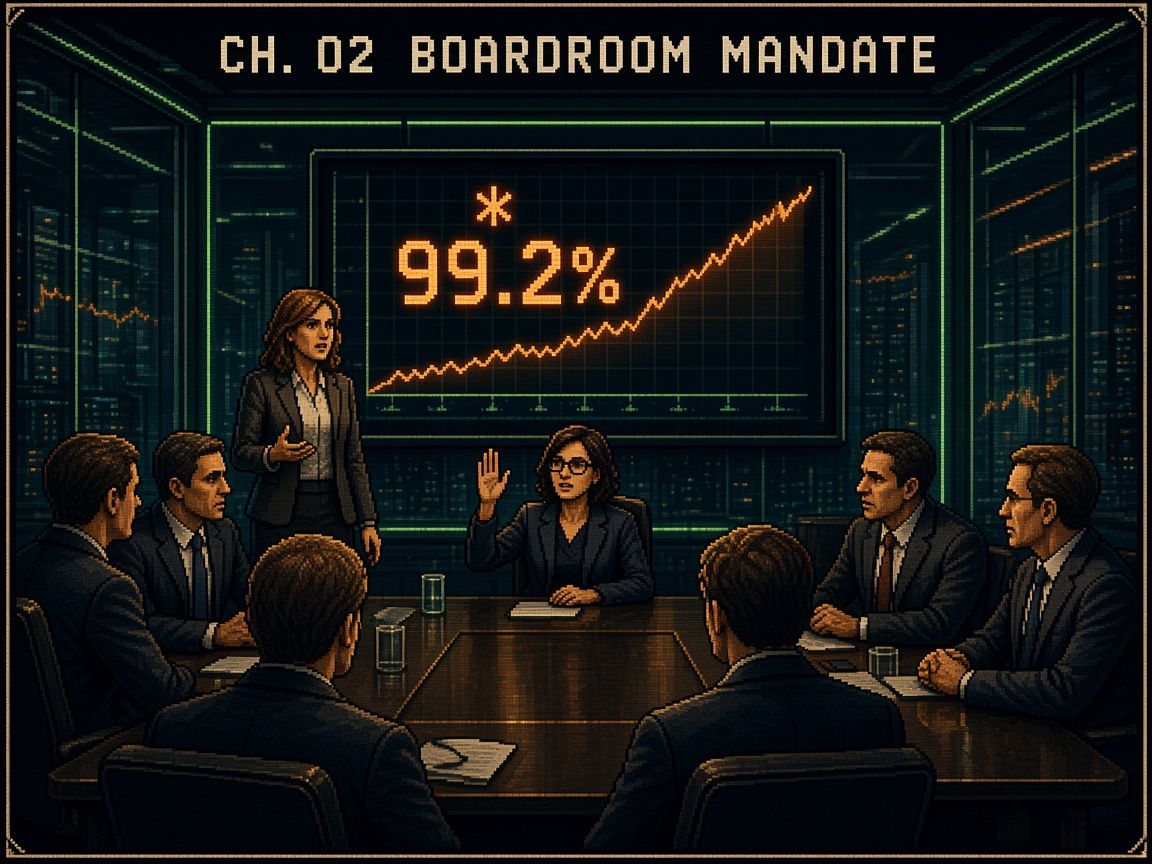
Chapter 2 — Boardroom Mandate
Claire Whitfield had learned to read a boardroom the way sailors read weather, and the room at 10 a.m. was a good one: attentive without being anxious, three of the five board members leaning forward instead of back, Harmon from the lead investor’s seat already nodding along to slide four before she’d finished narrating slide three. She had built this deck the way she built all of them — a story with a climbing line in it — and for thirty-one minutes it was working exactly the way stories were supposed to work.
Then she got to slide eleven, and Alex Chen, who had said exactly four words since sitting down, said a fifth and sixth: “Can I add something.”
It wasn’t really a question. Alex didn’t do questions when she wanted to interrupt; she did declaratives shaped like questions, a tic Claire had once found endearing and now, seventeen hours into a day that had started with a 6 a.m. call about an incident nobody had briefed her on properly, found less so.
“Of course,” Claire said, because you always said of course, and clicked back to slide eleven so Alex would have something to point at. Autonomous Resolution at Scale. The line. The 99.2%.
“That number’s accurate for the measurement window,” Alex said. “I want to be precise about what it’s a measurement of, before it goes into a room with people who are going to make commitments based on it. It’s ticket volume where the agent’s final action matched a human reviewer’s judgment of correct, sampled at five percent, over the trailing ninety days. It is not a guarantee about any individual ticket. It’s not an SLA metric. It’s a research metric that happens to look like an SLA metric if you don’t read the methodology footnote.”
Harmon, mild, curious, not yet alarmed: “Is there a reason to think it behaves differently than the aggregate suggests?”
Claire watched Alex decide, in real time, how much of last night to bring into this room. She could see the calculation happening — the woman had been awake since two in the morning solving an actual production fire, and Claire had known precisely none of that until forty minutes ago when Alex had pulled her aside before the meeting with a summary so clipped it had taken Claire a beat to understand she was being warned rather than briefed. Eight thousand dollars, contained, nobody outside Halden and us will ever know it happened, but I need you to hear it before you show that slide. Claire had absorbed it, filed it, and walked into the boardroom four minutes later with the deck unchanged, because the deck was right and the number was right and one contained incident, caught and fixed before the customer even fully understood what had happened, was not a reason to unwind a quarter of pipeline built on a genuinely strong product.
“There’s variance,” Alex said, choosing her words the way she chose everything, like each one cost something. “The aggregate is real. It’s also an average across a distribution with a tail, and the tail is where the expensive failures live — the ones where the system doesn’t just get an answer wrong, it acts on the wrong answer with real consequences before anyone notices. We had an incident last night that’s a clean example. Contained. No customer-visible harm. But it’s the kind of thing that doesn’t show up in a 99.2% unless you go looking for it specifically, and right now we don’t have the instrumentation to say how often it’s not getting caught.”
“Is Halden aware,” Harmon asked — to Claire, not Alex, which was the whole game of a boardroom in six words: the moment a technical caveat became a commercial exposure question, it came back to her.
“They will be, in the incident summary we send every pilot customer within forty-eight hours per contract,” Claire said, smooth, because this at least she’d had forty minutes to prepare. “It’s the kind of thing the contract is designed to handle gracefully. I don’t think it changes the fundamental thesis of the deck, which is that this line —” she advanced back to slide eleven, back to the number, because the number was still true even if Alex wanted an asterisk on it — “is heading in exactly the direction we told this board it would head in two quarters ago, and the market is telling us it’s ready to buy more of it than we’re currently able to sell, because we’re gating enterprise rollout behind a manual security review process that adds six to eight weeks to every deal.”
She felt Sloan’s absence in that sentence more than she’d have liked. Sloan wasn’t in this room — Sloan was never in this room, security leads didn’t get board seats at a company Meridian’s size — but Sloan’s fingerprints were all over the six-to-eight-week number, and Claire had spent enough calls with enterprise prospects watching deals go soft during that window to have a genuinely sincere, not-purely-political belief that it was costing them more than it was protecting them.
“Which is the actual ask on slide fourteen,” she went on, clicking forward before anyone could ask her to linger on eleven. “We formalize an Autonomous Enterprise tier. Contractual SLA on unassisted resolution rate, tiered pricing based on autonomy level, and — this is the part I need the room’s appetite read on — we commit two flagship accounts to it this quarter. Vantage Rail and the expansion at Halden itself, ironically. Both have told their champions internally they want this. Both are waiting on us, not the other way around.”
The room had the particular stillness of people doing math about their own compensation. Harmon spoke first, which he usually did. “What’s Alex’s view on the SLA specifically. Not the pipeline — the number in the contract.”
And there it was, the question Claire had been trying to route around for three slides, put directly enough that there was no routing around it now. She looked at Alex, and Alex looked back, and Claire understood — with a clarity that would sit uncomfortably in her chest for weeks afterward, long after she’d have cause to remember this exact exchange in far less abstract terms — that she was about to watch someone choose, in real time, between two kinds of loyalty that had quietly stopped being the same thing.
“I think we can build toward defensible SLA language,” Alex said. “I don’t think we’re there today. Contractual uptime commitments work because the systems behind them are deterministic enough that you can reason about worst case — a server is up or it’s down, and you can engineer for five nines because ‘up’ is a fact you can check. Correctness on an open-ended reasoning task isn’t like that. It’s a distribution. Right now we can tell you the mean. We can’t yet bound the tail, which is the part an SLA actually has to promise something about. I’d want three things before I’d sign off on this in a contract instead of a deck: a regression suite that tells us when a change makes the tail better or worse, not just the mean; hard limits so a bad run can’t compound the way last night’s did; and enough live monitoring that ‘this is happening more than usual’ is something we detect, not something a customer tells us. None of those exist yet. I can build them. I can’t build them by this quarter.”
Silence, of the kind that in a normal meeting Claire would have rushed to fill, and didn’t, because she recognized that filling it would look like overriding her own head of engineering in front of the board, and whatever else was true, she wasn’t going to do that.
Harmon, eventually: “How long.”
“Depends what we deprioritize to make room for it. Honestly — two quarters, if it’s actually the priority and not a project three engineers do in the gaps between fires.”
“Two quarters is not the answer the pipeline wants,” Claire said, and heard, even as she said it, how it landed — not as a rebuttal exactly, more like two true things being set down next to each other and left to make the room uncomfortable on their own. “Vantage Rail’s renewal conversation is in six weeks. If I go back and tell them autonomous tier is a two-quarter roadmap item, I lose the expansion, possibly the account. I’m not saying that to pressure Alex. I’m saying it because it’s the actual shape of the tradeoff this board needs to see, and I’d rather everyone see it clearly than have me paper over it and have this exact conversation again in a worse version, later, with a customer on the phone instead of a board member.”
She meant it, mostly. The part of the sentence she didn’t say out loud — the part she was aware of even as she chose not to say it — was that she had already, three weeks ago, told Vantage Rail’s champion informally that autonomous tier was “basically ready,” in the specific overconfident register that sales conversations rewarded and engineering conversations punished, and that going back now to soften that would cost her something with the champion that was hard to name and harder to get back once spent.
“What if it’s not two quarters versus zero,” Victor said.
Claire startled slightly; she’d half forgotten he was in the room, tucked into the observer’s chair against the wall where advisors sat when the board wanted their presence without their vote, silent through the whole first half of the deck in a way that had felt, in retrospect, less like inattention and more like someone waiting for the room to arrive at a question worth answering. Victor Aldana didn’t speak often in these meetings. When he did, people tended to actually stop.
“What’s the alternative,” Harmon said.
“Tiered honesty instead of tiered autonomy,” Victor said. “You don’t need the whole harness built to make a true, saleable claim today. You need to know, and be willing to say, exactly where the edge of what you can currently promise is — and build the SLA language around that edge, narrow as it needs to be, rather than around the number in the deck. A queue doesn’t fail because it has a limit. It fails when it promises no limit and gets one anyway. Sell the limit. Sell the honest one. Two accounts who are already asking for this are not going to walk away from a true, bounded promise made with confidence. They might walk away from a vague one that turns into a public incident.”
Claire opened her mouth to say something about how customers didn’t buy limits, they bought outcomes — a piece of sales doctrine so load-bearing in her worldview that she’d never had to examine it out loud before — and then didn’t, because some instinct older than the doctrine told her that arguing with Victor in front of the board about what customers wanted was a fight she’d regret picking today, whether or not she was right.
“I’ll take a version of that back to Vantage Rail,” she said instead, surprising herself slightly with how little it cost to say. “A narrower commitment, real, with teeth, instead of the broad one that isn’t ready. Alex, I’ll need your team to help me define exactly where the narrow version’s edge is, this week, not eventually.”
“That I can do this week,” Alex said, and something in her posture — Claire noticed it, filed it, would think about it again eleven months later at a very different kind of meeting — loosened by perhaps ten percent, the specific relief of a person who has spent a meeting bracing for a worse outcome than the one that arrived.
The board moved on to slide twelve. The line still climbed. Claire narrated it with the same confidence she’d rehearsed on the drive in, and it was, in every way the room could see, a good meeting — appetite read, ask calibrated, no one visibly alarmed. It was only afterward, alone in the elevator with the particular quiet of a pitch that had gone well enough to feel like relief rather than victory, that she let herself think about the sentence Alex had used in passing, almost as an aside, that she hadn’t managed to stop turning over since: last night’s incident. Not a possible failure mode. Not a theoretical risk. Something that had already happened, hours before she stood up, to a customer whose name was on a slide she was about to walk into a boardroom and use.
She made a note — an actual note, in the app, not a mental one she’d let slide by end of day — to ask Alex for the full incident writeup, and to read it before she called Vantage Rail’s champion this week rather than after. It was a small decision. She would not, for a long time, think of it as the first one she made differently because of anything Sloan or Victor or Alex had said to her. But it was.