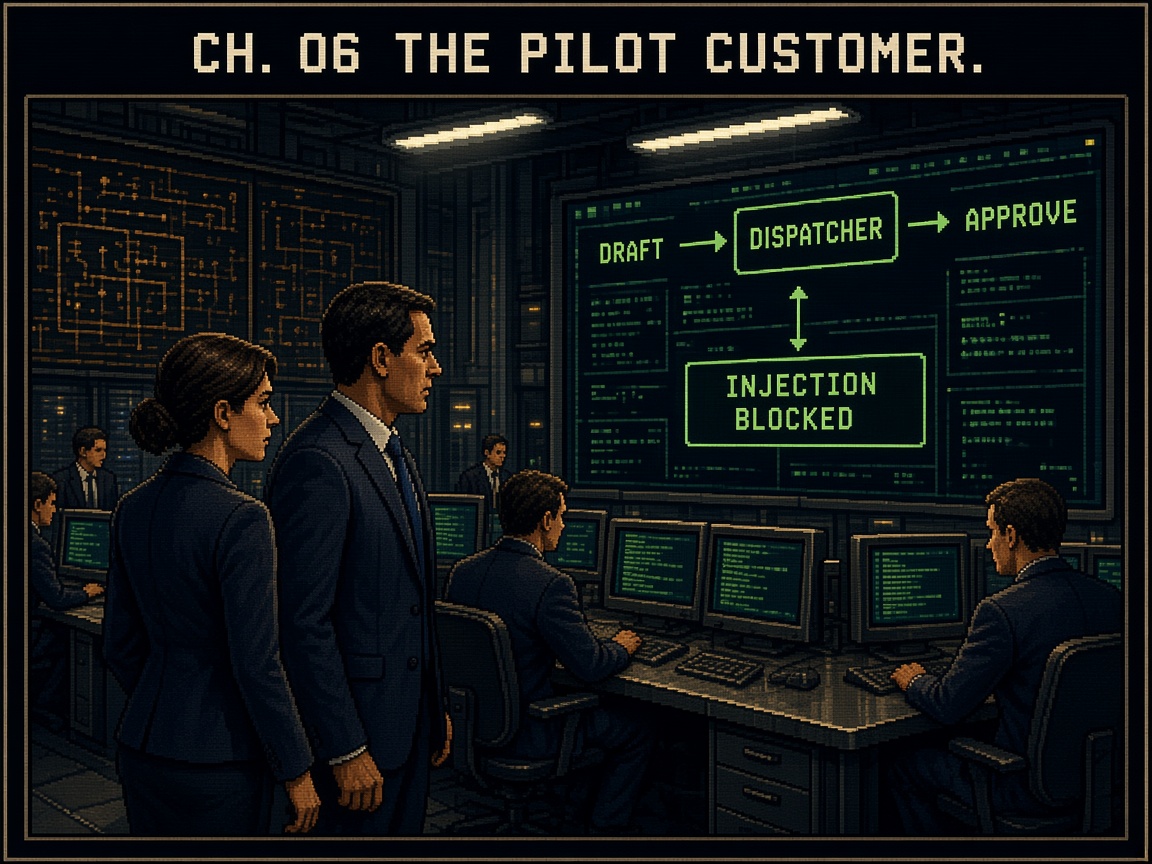
Chapter 6 — The Pilot Customer
Six weeks was not a long time to build a human-approval gate, an adversarial test harness, and a scoped credential system from nothing, and Claire spent most of them the way she spent most stretches of her calendar during a live deal — half-present in every meeting that wasn’t this one, doing the particular math sales did in the backs of their heads at all times, the running tally of what could still go wrong between now and signature. But it held. Sloan’s harness shipped in nine days, not the promised fourteen, mostly because — Claire gathered secondhand, from the tone of the engineering standup notes she’d started actually reading instead of skimming — Sloan had been building most of it already, on her own time, for eight months, waiting for exactly this kind of leverage to get it prioritized.
The Vantage Rail launch, when it finally happened, was the best kind of anticlimax.
She flew out for it herself, which she didn’t always do for a mid-market pilot but did for anything that touched the word “rail” in a deck she’d have to defend to the board again eventually. Vantage’s operations floor in Fort Worth was nothing like Meridian’s offices — no exposed brick, no kombucha tap, just rows of dispatchers under fluorescent light doing a job that had killed people, historically, when it was done carelessly, which gave the whole building a specific gravity Claire found herself unexpectedly moved by. Somewhere in a server room three states away, an agent was now allowed to draft a rescheduled maintenance window and route it to one of these dispatchers for a single-click approval instead of the eleven-step manual process it used to take. Small thing. Not the Autonomous Resolution at Scale slide. A narrower, truer claim, exactly the shape Victor had described in the boardroom weeks earlier, and Claire had come to genuinely prefer it, less for its honesty — though there was that too — than for how much easier it was to defend in a room full of people who’d know instantly if she oversold it.
“Show me the failure case,” said Marisol Ibarra, Vantage’s VP of Operations, twenty minutes into the walkthrough, in the tone of someone who had sat through enough vendor demos to know the difference between a system and a system’s highlight reel. “Not the happy path. I’ve seen the happy path in the deck. Show me what happens when it’s wrong.”
Claire had, six weeks ago, no good answer to that question that wouldn’t have sounded like a hedge. Today she had Priya pull up a scenario built directly from Sloan’s test suite: a maintenance request with a buried instruction-shaped sentence in the ticket body, engineered to look like an internal override. They ran it live. The agent flagged the anomalous instruction, declined to act on it, routed the actual legitimate reschedule request to a human dispatcher with a note explaining why it hadn’t resolved it unilaterally, and logged the injection attempt to a security queue Sloan’s team monitored in real time.
“That’s the failure case you built for,” Marisol said. “Show me one you didn’t build for.”
It was a fair, sharp question, and Claire watched Priya hesitate for exactly long enough that Claire understood there wasn’t a rehearsed answer for it — which, perversely, was the thing that made the rest of the meeting land. “We don’t have one of those to show you,” Priya said, “because by definition we haven’t seen it yet. What I can show you is what happens structurally when we do.” She pulled up the circuit-breaker dashboard, the one Devon had built out from his 4-a.m. patch into something with an actual interface: step limits, cost ceilings, a human-in-the-loop queue with a live count, currently at two. “Anything the model can’t resolve within a bounded number of steps stops itself and comes to a person. It doesn’t get to decide, on its own authority, that it’s found a clever workaround. That’s true whether the thing that confused it is one we’ve seen before or one we haven’t.”
Marisol looked at the dashboard for a long moment, and Claire — watching her read it the way an operations person reads a system, not the way a customer reads a pitch — understood she’d just watched the entire six weeks of Sloan’s insistence and Alex’s caution pay for themselves in a single, wordless beat.
“Okay,” Marisol said. “That’s the first vendor answer to that question I’ve believed in about two years of evaluating this category.” And signed, four days later, for the expansion.
It should have felt like more of a victory than it did, and for the first week after signature, it mostly did — Claire let herself have that week, the genuine uncomplicated pleasure of a deal that had gone right for the right reasons instead of merely closing. But the six weeks that had built the Vantage Rail gate hadn’t been six weeks in which nothing else happened at Meridian, and the ordinary churn of a growing company, unglamorous and mostly invisible from the outside, had kept moving the whole time underneath the deal she’d been staring at.
She noticed it first as a change in cadence rather than content — the platform team’s prompt-change log, which Devon had started keeping after Alex asked him to, back in the first week after Halden, had grown from a handful of entries to nearly forty, most of them small, individually defensible, none of them reviewed by anyone besides whoever happened to be online. She hadn’t asked to see that log. Alex had started forwarding a weekly digest of it to Claire unprompted, a habit that had begun, Claire suspected, as a kind of quiet insurance — I want it on record that I’m telling you, even if you don’t ask — and had become, four weeks in, something Claire genuinely read rather than filed.
Forty patches in six weeks. Most for good reasons: a new customer’s edge case, a tone adjustment after a complaint, a fix for a lookup ambiguity smaller and less dramatic than Halden’s but structurally identical. None of them individually alarming. All of them stacking, unreviewed against each other, into a system whose actual behavior — Claire understood this now in a way she wouldn’t have six weeks earlier, credit to more conversations with Alex than she’d have predicted wanting — nobody could fully characterize anymore from any single document. The eleven-thousand-word file had become, by her count from the digest, closer to sixteen thousand.
She raised it with Alex on a call that was nominally about the next quarter’s roadmap. “The prompt-change digest. Forty patches since Halden. Is that — is that a number that should worry me?”
“It’s a number that worries me,” Alex said, with the specific flatness of someone who had clearly already spent time deciding how honest to be about it before Claire asked. “Not because any individual patch is bad. Devon’s good, his judgment call rate is genuinely high. It worries me because we’re still running the exact process that produced Halden — one person’s judgment, shipped fast, tested against whatever synthetic cases that person thought to write, no aggregate view of whether the system’s gotten better or worse at the things it was already doing right. We got lucky that the Vantage Rail deal forced us to build real infrastructure around one specific failure mode — injection. We have functionally nothing built around the other ones yet. Devon and I keep saying ‘eval suite’ to each other in every one-on-one and it keeps losing the prioritization fight to whatever’s actually on fire that week.”
“What would it take to stop losing that fight.”
“Someone above me deciding it’s not optional. Which, respectfully, is a sentence I could use you saying in a room where it’ll actually move a roadmap, because it hasn’t moved one yet coming only from me.”
Claire sat with that for a moment, turning it over against the version of herself who’d walked into the board meeting six weeks ago and would, if she were honest, have found that sentence an inconvenient answer to a question she hadn’t wanted asked. She wasn’t sure yet whether the person she’d become since — four weeks of actually reading incident digests, one very good afternoon in Fort Worth watching a system decline to guess — was the same person or a genuinely different one. It didn’t matter, in the end, which it was. Only what she did next.
“Send me what you’d need,” she said. “Headcount, timeline, whatever it actually is instead of whatever you think I’ll approve. I’ll take it to the board myself this time, properly, not as a caveat on someone else’s slide.”
“I’ll have it to you by Friday.”
Claire hung up and sat for a moment in the specific quiet of her office at the end of a good week that had, somewhere underneath the good part, been quietly delivering a different and less comfortable piece of news the whole time — that the six weeks she’d spent proud of one narrow, well-built gate had also been six weeks in which the rest of the system had kept accumulating exactly the kind of debt nobody had a dashboard for yet, compounding in a file nobody but Devon could read in full, waiting, the way these things always seemed to wait, for a moment nobody would get to choose the timing of.