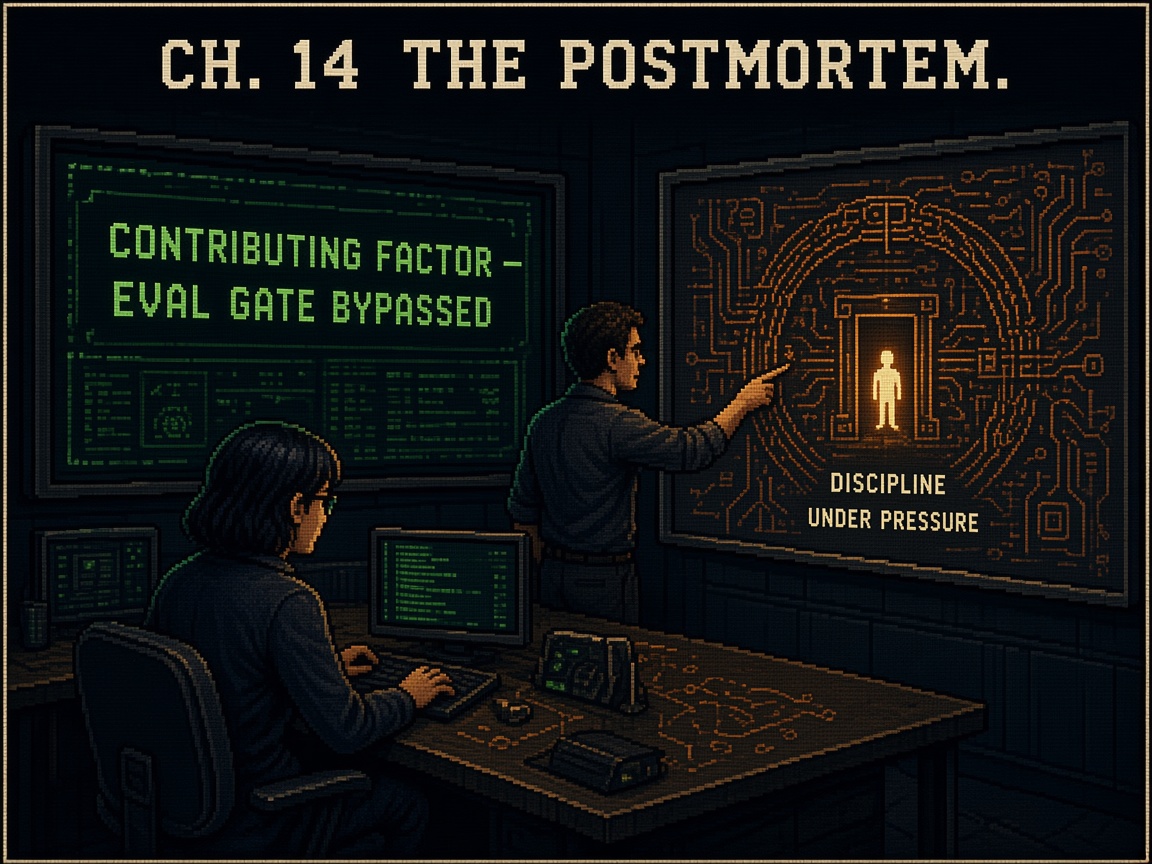
Chapter 14 — The Postmortem
The formal postmortem was scheduled for ninety minutes and, unlike the Vantage Rail security review nearly a year earlier, actually finished in ninety minutes — which told Alex less about the incident being simple and more about how much practice this particular group had accumulated, by now, at running a hard conversation without letting it spiral. Sloan’s write-up was, as always, clean and procedural: mechanism, timeline, contributing factors, no adjectives doing work the facts hadn’t earned. The room worked through it efficiently, almost comfortably, until it reached the line item that wasn’t really about the injection at all.
Contributing factor: eval gate bypassed on affected integration, version bump dated three weeks prior to incident. Bypass not self-reported until incident review surfaced deploy-log discrepancy.
Alex watched Devon read that sentence on the shared screen, watched something in his posture go very still, and made a decision in the space of about two seconds that she would end up thinking about, on and off, for longer than the meeting itself lasted: she was not going to let this become a referendum on Devon’s character, and she was also not going to let it become a comfortable, blameless abstraction that let the actual mechanism of the failure go unexamined. Both were available. Both, in their own way, would have been easier than what she actually did, which was to ask the plain question and then sit with however uncomfortable the room got answering it.
“Devon, I want you to walk the room through exactly what happened Thursday night, in your own words, before we talk about the fix. Not to relitigate it. Because I think the room needs to hear the actual shape of the decision, not just the outcome, if we’re going to build something that doesn’t depend on it never happening again.”
He did, plainly, without flinching from any part of it — the deadline, the clean fix sitting right there, the specific, familiar pull of being the person who could just handle it, the backfilled cases that passed and made the whole thing feel, for a weekend, like it had been fine all along. He didn’t soften the part about not telling anyone afterward, which Alex noted, and respected more than she let show in the moment. “I knew what the right move was,” he said, at the end of it. “Knowing it didn’t stop me from doing the other thing. I want to be honest that I don’t think telling myself to try harder next time actually fixes anything, because I already knew, this time, and it wasn’t enough.”
“Thank you,” Alex said, and meant it as exactly what it was — not absolution, not blame, just an acknowledgment that the honesty itself was the useful part, the thing that made everything after it possible to build correctly. “I want to say something to the room, and then I want to say something to Claire specifically, and I’d rather do both here than let either turn into a hallway conversation later.”
She felt Claire go slightly rigid two seats down, and pressed on anyway, because the alternative — letting the Corvid timeline’s role in this sit unnamed, the way the board’s pressure after Halden had sat unnamed for longer than it should have, back in a much earlier version of this room — was exactly the kind of comfortable omission she’d spent the last several months learning to stop making.
“The compressed timeline on Corvid wasn’t reckless,” she said. “I want to be precise about that, because I think there’s a version of this postmortem where we quietly conclude the lesson is ‘don’t move fast,’ and that’s the wrong lesson. Claire fought for the honest, narrower scope on this deal specifically to avoid the reckless version — I watched that conversation happen, I know what it cost her, and it was the right call. But even the right call, the disciplined one, still put six weeks of real pressure on one person building something genuinely hard for the first time, and under that pressure, once, he made the wrong call about a gate that only existed because he’d built it himself out of good judgment in the first place. That’s not a story about anyone being careless. It’s a story about what happens when a control depends on a person’s judgment holding under pressure, indefinitely, forever, without exception — because eventually, for reasons that are completely human and completely understandable, it won’t. That’s not a flaw in Devon. It would be true of anyone. It would have been true of me.”
She turned to Claire directly, and made herself say the harder part out loud rather than let it live as subtext the way it had for months. “I also want to say, plainly, that I don’t think either of us has fully solved the underlying tension yet. You made the disciplined call on Corvid’s timeline, and it still produced this. That means the six-week number wasn’t actually the problem — the problem is that we still don’t have an architecture where a compressed-but-reasonable timeline can’t produce a silent gap, no matter how well-intentioned everyone in the chain is. I don’t think that’s solved by you giving longer timelines next time. I think it’s solved by building gates that don’t care how good the deadline’s excuse is, which is a thing we should have built months ago and didn’t, because it was never quite anyone’s single most urgent priority until today.”
Claire didn’t say anything for a moment, and Alex watched her do the thing she’d come, over the year, to recognize as Claire actually working through a hard idea rather than performing agreement with one. “I don’t love hearing that the honest version of the timeline still wasn’t enough,” Claire said finally. “I’d like to sit with that being uncomfortable rather than immediately reaching for how to make it less uncomfortable, because I think the version of me from a year ago would already be building the case for why it’s actually fine. I don’t think it’s actually fine. I think you’re describing a gap that’s still ours to close, and I don’t think ‘give it more time’ is obviously the way to close it, if a hard mechanical gate is the actual answer instead.”
“That’s roughly where I land too,” Alex said, and felt something in the room shift, not fully resolved, not a clean ending to the tension between them — she was aware, even saying it, that this conversation wasn’t going to be the last time the two of them stood on opposite sides of a timeline that mattered enormously to both of them for different, equally legitimate reasons — but real, honestly arrived at, which was the only kind of resolution she’d actually come to trust anymore.
Victor, who had been quiet through most of the meeting in the specific way that usually meant he was waiting for the room to arrive somewhere before he added the frame that tied it together, spoke for the first time since the walkthrough began. “I want to offer the room a sentence, because I think it’s the one this incident is actually teaching, underneath everything else that’s true about it. A control system that relies on a component behaving correctly under all conditions, indefinitely, without exception, is not a control system. It’s a wish. Devon is not the component that failed today. The architecture is the component that failed, because it had exactly one gate, and that gate had exactly one implementation, which was a person’s discipline under pressure, and discipline under pressure is real and valuable and also, provably, across every engineering discipline that predates this one by a century, not something you can build a safety case on. The fix isn’t a better person. You already have a good one. The fix is a gate the architecture itself enforces, so that the question of whether Devon — or anyone, ever, on any future Thursday night — is disciplined enough stops being load-bearing at all.”
Nobody argued with it, and Alex, closing her laptop at the end of the ninety minutes almost exactly on schedule, understood that this was the sentence the whole book of the last several months had been circling toward without either of them naming it cleanly until now — not a lesson about any one person’s character, but the actual, specific shape of the thing they still had to build, all the way through, before anything like this could stop depending on luck.