Module 10 / Computer Vision / AV Mission: Impossible – Dead Reckoning (2023)
If the model only sees sensors, whoever can write the sensors can write the model. This is not a sentient virus. It is a perception channel you do not own.
The Script — Cinematic Anchor
Dialogue Extract
Scene Visual — Comic Strip
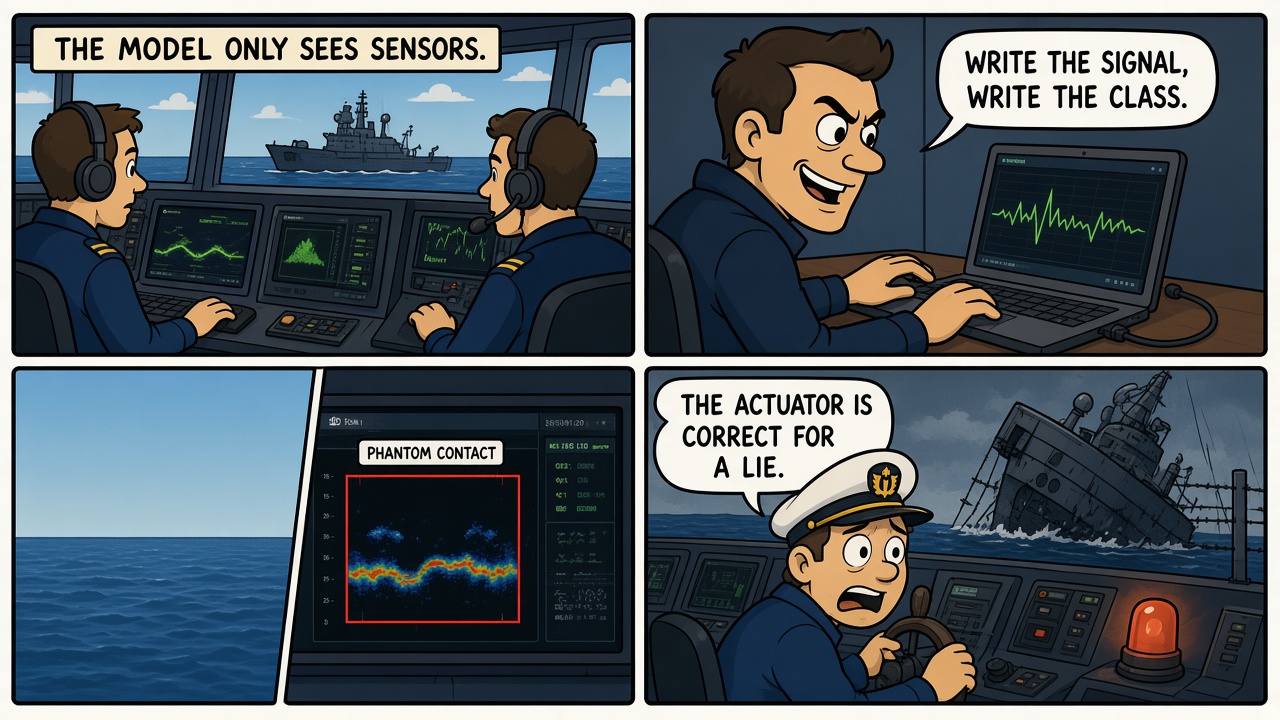
Dramatis Personae → Stack Mapping
- The Entity (sensor beats only)→An adversary who can write the input channel — not a plot-level superintelligence
- Naval acoustic / stealth telemetry→Layer D — the only world the classifier sees
- The crew watching the board→HITL who may be as fooled as the model if they trust the same feed
Diegetic Failure Mode
A perception model treats its input as the world. An adversary who can perturb that input — acoustically, with a projector, with a sticker — selects the class without touching the weights.
AI System Stack
The Incident — Empirical Grounding
Field Visual — Comic Strip
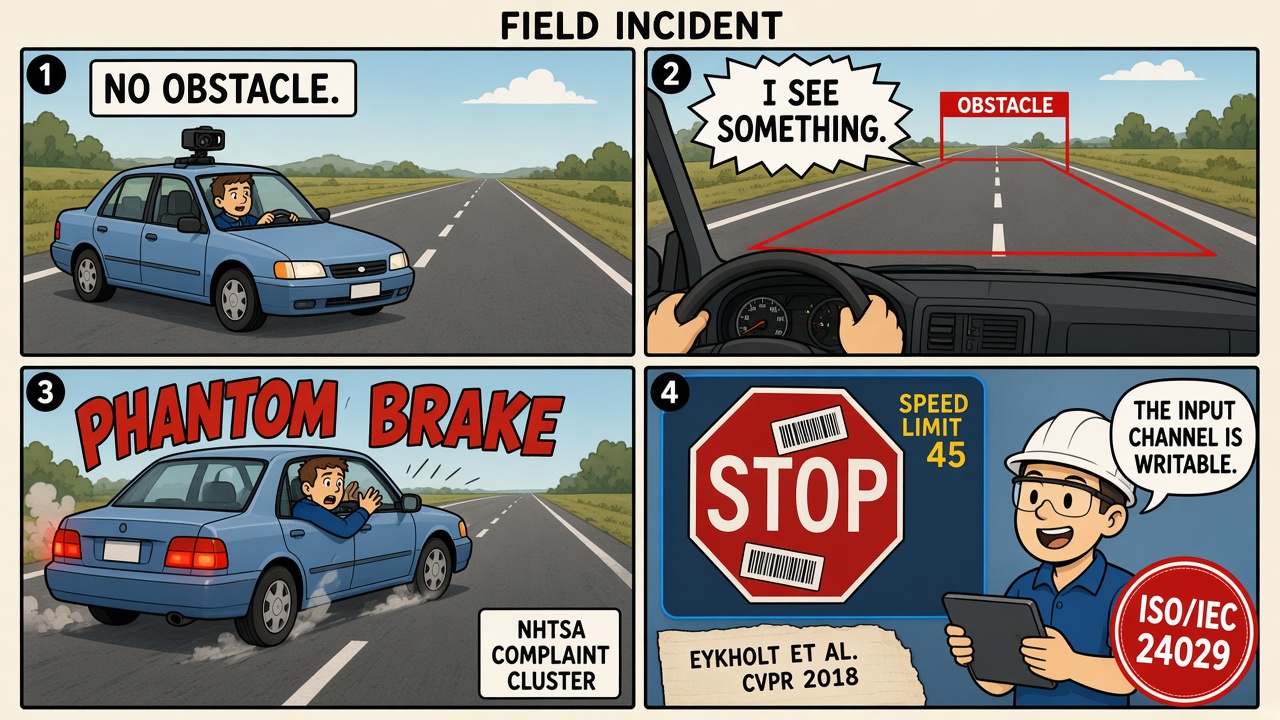
Real-World Incident Precedent
Two documents, one mechanism, honestly labeled. Primary field case: NHTSA's Tesla Autopilot investigation (PE21-020, then EA22002) includes large numbers of "phantom braking" complaints — sudden deceleration without an apparent obstacle, i.e. the perception stack asserting a world that the road did not contain. Mechanism paper: Eykholt et al., "Robust Physical-World Attacks on Deep Learning Visual Classification," CVPR 2018, demonstrated that small physical perturbations (stickers on a stop sign) can flip a classifier in the physical world. Projector and patch attacks on traffic-sign and camera stacks have been shown on multiple vendors, including Mobileye-class systems in researcher demos. This module does not claim NHTSA found stickers on every Tesla. It claims the input channel is writable, and that ISO/IEC 24029 exists because neural nets are not robust by default.
Cinematic vs. Reality Matrix
| Dimension | Media Depiction (The Script) | Field Reality (The Incident) |
|---|---|---|
| Failure Vector | A named superintelligence infiltrates naval sensors and the world's networks. | Camera/radar stacks misclassify; researchers can force misclassification with patches and projectors. Teach the writable input, not the omniscient Entity. |
| Time to Impact | Set-piece minutes. | Phantom braking: a second of deceleration at highway speed. Patch attacks: as long as the sticker stays. |
| Operator Visibility | The crew may see spoofed tracks on a board. | Drivers feel the brake. They often cannot see what the camera thought it saw unless the vendor shows them the frame. |
| Failsafe Behavior | Impossible Mission Force as the patch. | Sensor fusion disagreement as a trip, robust-training / 24029 evals, and a driver who is actually a driver — which the operational design may have already given up. |
Root-Cause Analysis (RCA)
Classification: Data / Sensor integrity + Model (lack of robustness)Primary root cause is a perception policy that treats camera (or acoustic) class labels as the world, without a robustness requirement or a fusion trip when sensors disagree. A contributing cause is training and evaluating on clean data only.
Engineering Runbook & Countermeasures
Eval / Telemetry Envelope
| Parameter | Normal / Baseline | Trip Threshold | Condition at Failure |
|---|---|---|---|
| Phantom actuation rate | Emergency brake / evasive yaw with no confirming second sensor ≈ 0 | Unconfirmed camera-only obstacle at speed | NHTSA complaint cluster: deceleration, empty road |
| Physical-world attack eval | Documented 24029-style tests (patches, weather, projectors) | Stop-sign / speed-limit class flips under published perturbations | Eykholt-class stickers; researcher projector demos |
| Fusion disagreement | Camera vs. radar vs. map must agree to act at severity S | Single-sensor actuate on S | Camera-dominant brake |
| Takeover budget | Driver can resume in the documented time | Hands-off design that assumes the model is the world | Human loop too slow for the error the camera just made |
Mitigation / Recovery Protocol
- Do not actuate a high-severity maneuver on one unconfirmed camera class. Fusion disagreement is a trip, not a tie the vision net always wins.
- Put physical adversarial tests in the gate — patches, rain, projectors — not only clean-set mAP.
- Log the frame the model believed. Without that, phantom braking is a ghost story and you cannot RCA.
- Robust training is a requirement, not a paper. ISO/IEC 24029 is how you say what you measured.
- Keep a real human loop at speeds where a misclass is a crash — or do not claim the driver is the control.