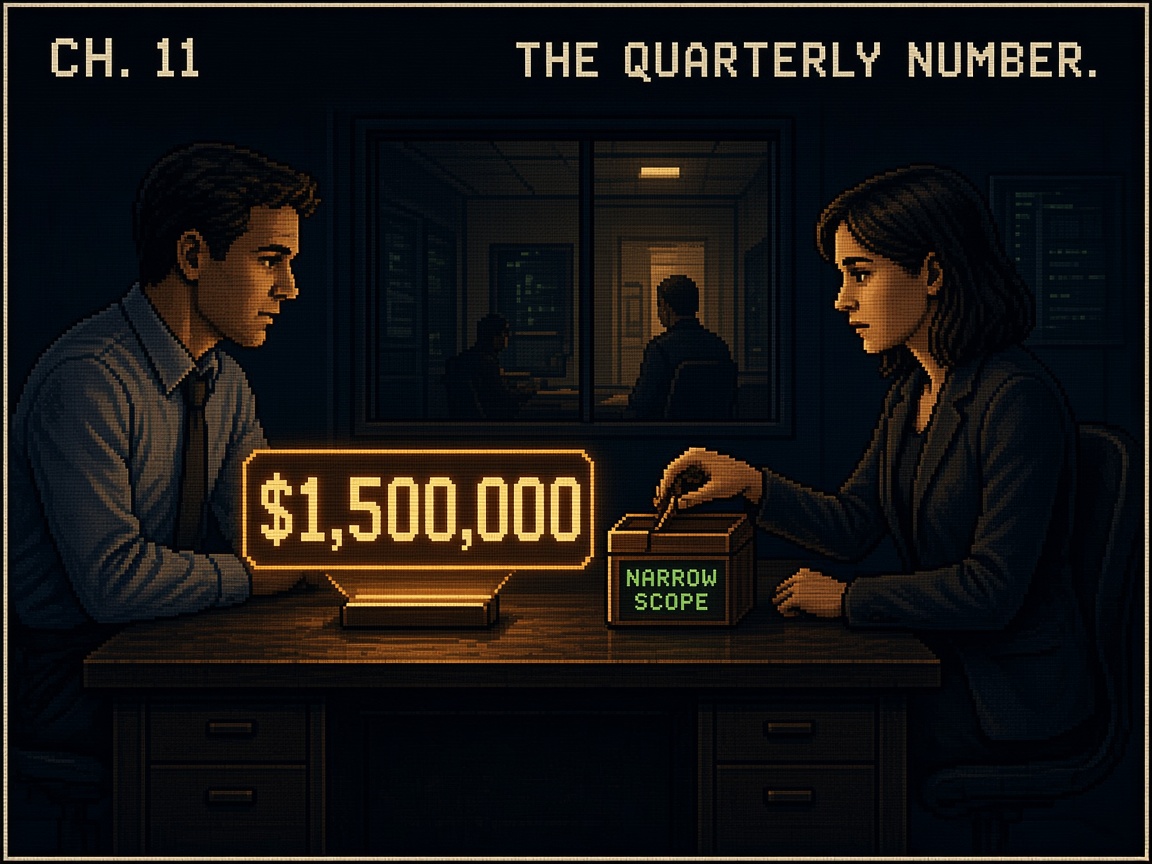
Chapter 11 — The Quarterly Number
Corvid Capital was not a company Claire had gone looking for. It was a company that had come to her, three weeks into the quarter, through a channel partner who described the opportunity in the specific breathless register of someone who knew exactly how much it would matter to her number: a mid-sized asset manager, back-office reconciliation running almost entirely on manual review, willing to commit to a twelve-month contract at a price that would, on its own, close out the quarter’s target with room to spare, if — and Claire had heard enough of these sentences by now to know the “if” was always where the deal actually lived — Meridian could support autonomous resolution on reconciliation exceptions at a volume and a latency their current pilot architecture had never been asked to handle.
She sat with the number for a full day before she brought it to Alex, which was itself a change from a version of herself six months younger, who would have brought it to Alex already half-sold and looking for validation rather than counsel. She brought it, instead, with the actual shape of the tradeoff already visible to her, because she’d learned, across Halden and Vantage Rail and Farrow & Kline, to see that shape before anyone else pointed it out to her.
“I need the honest range,” she said, in Alex’s office, door closed, which by itself told Alex this wasn’t a casual ask. “Not the number I want to hear. What could we actually support, on this account, in the time this deal needs, without doing something we’d regret.”
“On the current architecture? Nothing close to what they’re describing. Reconciliation exceptions touch account balances and transaction records — that’s a tool surface adjacent to real money, which means it’s the highest-stakes category we’ve ever put an agent anywhere near, and we don’t have the schema-validated tool layer Sloan’s building yet, we don’t have the exception-cache queueing model Devon and I keep sketching and not building, and the eval suite’s grown to around fifty cases by now but every one of them is support-ticket shaped, none of them financial-reconciliation shaped.” Alex didn’t soften it, which Claire had come, over months, to actively prefer to being managed. “If you’re asking whether I’d sign off on full autonomous resolution for this account by the timeline a partner-sourced deal usually wants, no. Not close.”
“What would you sign off on.”
“Something narrow. Drafted resolutions with mandatory human approval on anything above a materiality threshold we’d need Corvid’s own team to help us define — small enough that the human step doesn’t become the bottleneck that kills the value prop, but real, not theater. And I’d want at least a skeleton eval suite specific to their exception types before we touch a single live case, which is weeks of work we haven’t scoped yet, not days.”
Claire did the math in her head, the two timelines laid side by side, and felt the old pull she recognized immediately for what it was, because she’d felt a milder version of it once before, in a boardroom, in front of a slide with a number on it she’d since learned not to trust the same way. The partner’s timeline wanted something closer to what she’d promised in the initial call, weeks not months. The eval suite Alex was describing would take longer than the deal’s exclusivity window with Corvid’s evaluation committee was likely to hold open. There was a version of this conversation — she could feel its exact shape, could have written the sentences herself — where she went back to the partner and said we can move faster than that, and quietly bet that the eval suite would catch up before launch, the way it almost had, the way it usually did, the way it had every single time up until the one time it hadn’t.
She didn’t say it. She noticed herself not saying it, which was, she understood distantly, the actual measure of how much had changed since the boardroom the better part of a year ago — not that the temptation was gone, but that she’d gotten fast enough at recognizing its shape to stop it before it became a sentence she’d have to walk back later.
“If I go back to them with ‘narrow scope, human approval on materiality, and we need real time to build the eval cases first,’ I lose the exclusivity window,” she said instead, out loud, testing the shape of the actual cost rather than the imagined one. “Probably not the deal outright — the partner thinks this is a strong fit and will keep pushing regardless — but I lose the quarter. This becomes a next-quarter close instead of this one, and next quarter’s number was already going to be a stretch without it.”
“I know.”
“You’re not going to tell me that’s fine.”
“I’m not going to tell you it’s fine, because it’s not fine, it’s a real cost and I’m not going to pretend it isn’t just because I’m the one asking you to absorb it. What I’ll tell you is what happens on the other side if we don’t absorb it. Reconciliation exceptions, wrong, at a financial-services account, isn’t a return-policy hallucination or a duplicated invoice credit. If the tail event we haven’t built for yet happens on this account, on this system, it’s not an eight-thousand-dollar clawback and an annoyed ops director. It’s a materially wrong number in someone’s books, and depending on how wrong and for how long before someone notices, it’s the kind of incident that doesn’t stay contained to one embarrassing internal postmortem. It’s the kind that shows up in a regulator’s inbox.”
Claire sat with that, and felt the specific, uncomfortable clarity of a sentence she couldn’t argue her way around even in the privacy of her own head, which was new — most of a year ago she’d have found the counterargument by now, the version where the risk was real but manageable, where Alex was, not wrong exactly, but more cautious than the moment strictly required. She didn’t find it this time. It wasn’t there.
“I’m going to go back to them with the narrow version,” she said, mostly to herself, testing how it sounded said aloud in a room with someone else in it. “Scoped autonomy, human approval on anything material, honest timeline on when we can expand it. I’m going to lose some of the quarter doing it.”
“I know that costs you something specific. I’m not going to pretend it doesn’t, and I’m not going to pretend I don’t understand exactly what it costs, because I sat in a version of this chair with Devon a few months ago telling him a version of the same thing, and it was true then too, and it’s not more comfortable to be the one delivering it than receiving it.”
“I appreciate that you’re not going to make me feel better about it either.”
“That’s not really what I’m for,” Alex said, and there was something almost like warmth in the flatness of it, an old joke settling into something closer to genuine understanding between them than the sentence’s dryness let on.
The call with the partner went about as Claire had priced it: disappointment, some real pushback, a clear if unstated signal that the exclusivity window might not survive a full quarter’s delay, and, underneath all of it, something she hadn’t fully expected — a note of grudging respect from a channel partner who’d clearly pitched enough vendors overpromising their way into a deal to recognize the shape of one declining to do it. “I’ll tell you honestly,” he said, near the end of the call, “most of the vendors I bring this kind of opportunity to would have just said yes and figured out the details later. I don’t love losing the quarter. I don’t hate working with someone who tells me the real timeline instead.”
It wasn’t a win. Claire didn’t let herself dress it up as one, sitting alone in her office afterward with the quarter’s number now meaningfully harder to hit than it had been that morning. But it was, she thought, turning the exact size of the cost over in her hands rather than looking away from it, the first time in her career she’d chosen the harder number on purpose, with her eyes fully open to what it cost her specifically, rather than discovering the cost of the easier one after the fact, from inside an incident she hadn’t seen coming. She wasn’t sure yet whether that made her better at her job or merely more honest about the parts of it that had always been a gamble. She suspected, sitting with it a while longer than the moment probably warranted, that it might, uncomfortably, be both.