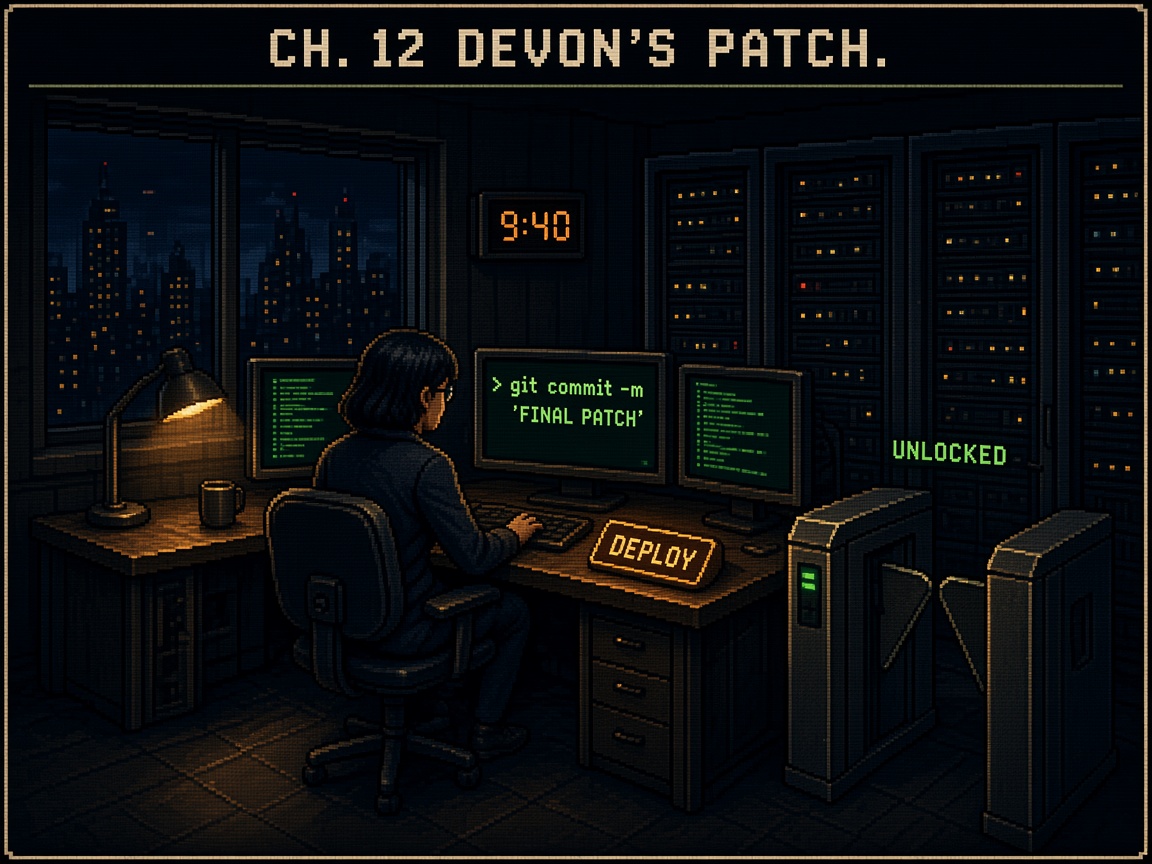
Chapter 12 — Devon's Patch
The Corvid Capital timeline was honest, which did not make it easy. Six weeks to stand up a scoped reconciliation-exception agent, a materiality-threshold approval gate, and — the part that actually fell on Devon’s desk, underneath every other piece of it — a first real eval suite for a task category the company had never built for before, financial exception handling being nothing at all like a support ticket about a late shipment. He had, by his own count, built maybe a third of it by the start of week five, and the honest, narrower scope Claire had fought for was starting to feel, from inside the work itself, exactly as tight as the aggressive one would have.
He’d stopped minding the eval gate weeks ago, which surprised him a little every time he noticed it — the four-month regression from Chapter 9 had done something to his relationship with the whole discipline that no amount of Alex’s careful framing back in his first week had quite managed on its own. He believed in it now, not as a rule imposed on him but as a thing that had, once, concretely, caught something he would have missed. That belief did not make Thursday of week five any less brutal.
The specific problem was narrow and, in isolation, almost boring: Corvid’s exception categories used a piece of internal jargon — “aged variance,” a transaction discrepancy that had sat unreconciled past a specific number of business days — that the agent kept confusing with an unrelated, superficially similar term from a different part of Corvid’s own documentation, “aging schedule,” which described something about depreciation entirely unrelated to reconciliation. The confusion was subtle enough that it hadn’t shown up in the eleven cases he’d already built for the suite, and specific enough that fixing it properly meant not just a one-line prompt edit but restructuring how the agent disambiguated Corvid-specific terminology against its general reconciliation training — real work, the kind that needed its own eval cases built alongside the fix, at least four or five of them, to make sure the disambiguation held across every context the term could appear in.
He didn’t have time to build four or five new eval cases and get the fix through review and re-run the full suite before Friday’s checkpoint call with Corvid’s evaluation committee, the one where Claire needed to show visible progress or risk the whole narrow-scope compromise looking, to a skeptical committee, like it was already sliding behind schedule.
He knew, with total clarity, what the correct move was. He’d have told anyone else on the team exactly what it was, without hesitation, in the same clipped tone Alex had used on him most of a year ago: push the checkpoint, tell Claire the honest reason, eat the awkward conversation, protect the process. He knew it the way you know a fact you’ve filed correctly and can retrieve on demand. Knowing it and feeling the specific, familiar pull of Thursday night at 9 p.m., alone, the prompt file open, one clean edit visibly sufficient to fix the exact failure mode in front of him — those turned out, in the moment, to be two very different experiences of the same knowledge.
He told himself a version of the old story. I’ll ship the narrow fix tonight, unreviewed against the full suite, and backfill the four or five cases this weekend, before anyone but me would ever know the gate got skipped. It wasn’t even really a lie, not in the moment — he half believed it, the way he’d half believed every fast patch he’d ever shipped was a temporary, victimless shortcut rather than a debt with its own compounding interest. It felt, sitting there at 9 p.m. with the fix already drafted, exactly like it used to feel fourteen months ago: competent, fast, useful, the private, unshared satisfaction of being the person who could just handle it, no committee, no process, no delay — the same feeling Alex had named as a liability back in Chapter 3 and that he’d genuinely believed, until tonight, he’d mostly outgrown.
He shipped it at 9:40, unreviewed, untested against the suite, a single targeted prompt change disambiguating “aged variance” from “aging schedule” with three hand-written examples he was confident — reasonably confident, not certain, a distinction he noticed and set aside — covered the failure mode cleanly.
It worked. That was, in its way, the worst possible outcome, because it meant nothing caught it, nothing forced the reckoning that would have made the lapse impossible to avoid examining. The Friday checkpoint call went well; the specific failure Corvid’s team had flagged in Thursday’s test data didn’t recur; Claire thanked him, genuinely, unaware there was anything to thank him for beyond ordinary competent work. He felt the particular, corrosive relief of having gotten away with something, which was different in kind from the relief of having done something right, and he knew the difference, lying awake later that night turning it over, in a way he wouldn’t have been able to the better part of a year earlier, before Alex had ever named the pattern out loud to him.
He thought, more than once over the weekend, about telling her. About walking into Monday’s standup and saying, plainly, I skipped the gate Thursday night, it happened to hold, but I skipped it, and I want that on the record the way everything else in my patch list is on the record. He rehearsed the sentence a few different ways, in the shower, on a run, in the particular unproductive insomnia of 1 a.m. on a Sunday. Each time, a quieter, more persuasive voice offered him the same counter-argument, dressed up a little differently each pass: it worked, backfilling the cases this weekend closes the gap before anyone would ever check, and bringing it up now costs something real — a dent in exactly the trust Alex has spent seven months building with him — for a risk that’s already, provably, behind him.
He backfilled the cases Sunday night. All five passed, cleanly, against the fix he’d already shipped, which he told himself was confirmation rather than luck, a distinction that mattered enormously and that he did not examine closely enough to notice he was choosing not to examine it.
He did not tell Alex.
It wasn’t a decision, exactly, not the kind with a moment attached to it he could point back to later and say there, that’s where I chose wrong. It dissolved, instead, into the ordinary texture of a Monday that had other, louder things in it, and by Tuesday it had the specific, settled quality of a thing that was no longer being actively decided at all, just quietly, permanently not said — filed, in some back room of his own accounting of himself, under handled, a word doing a great deal more work than it had earned.
He went back to the patch list that evening, out of habit more than anything, and added the entry the way he always did — failure mode, fix, what he’d tested. He wrote the true version of what he’d tested: five backfilled cases, passing. He did not write the true version of the order in which any of that had happened, or that the fix had spent three days in production before a single one of those five cases existed to check it against. The list, read cold by anyone else, would say the process had held.
He closed the laptop, and did not think about it again for some time, which was, in retrospect — though he would only be able to see this clearly much later, from the other side of a much worse week than this one — the most dangerous part of the whole thing. Not the shortcut itself. The fact that taking it, once, and getting away with it clean, had made it so easy to stop thinking about at all.