Chapter 16 — The Circuit Breaker
The mandate that came out of the Corvid postmortem was blunt enough that Devon had half expected more resistance than it actually got: every deploy pipeline for every agent at Meridian, customer-facing or internal, would run through a single, shared gate before anything shipped — schema validation on tool calls, a passing eval run against that integration’s suite, and, new since the postmortem, a hard circuit-breaker framework generalized from the step limit he’d hand-written at 4 a.m. eleven months earlier into something any team could adopt without reinventing it from scratch.
He’d been given ownership of the last piece, which felt, walking into the first working session, like being handed back something of his own that had grown considerably since he’d last held it.
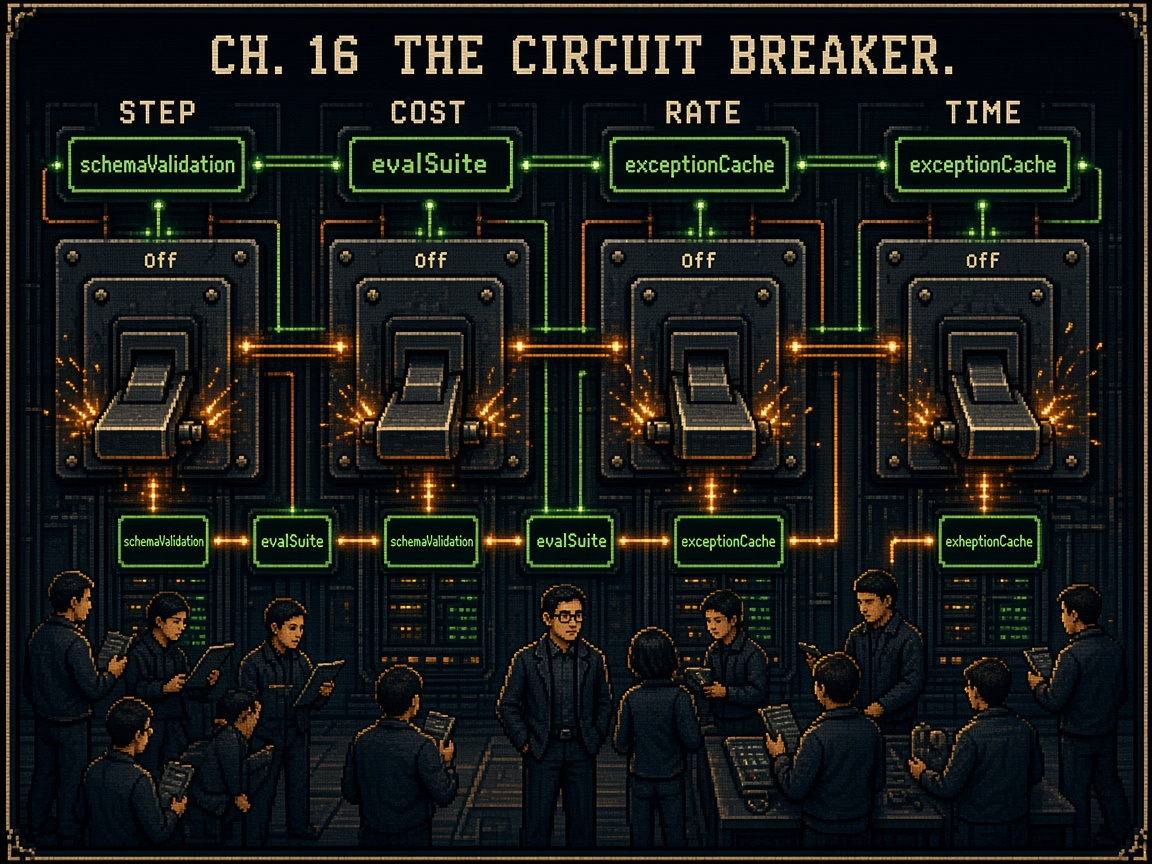
“Four kinds of limit,” he told the room — a dozen engineers now, platform and product teams both, pulled together for what Alex had started calling, only half-jokingly, the Governance Working Group, a name Devon privately thought was doing a lot of work to make a genuinely unglamorous project sound important enough to staff properly. “Step count, same as the original Halden fix — a hard ceiling on how many tool calls or reasoning iterations a single task can take before it stops and escalates instead of continuing to try. Cost ceiling, dollar-denominated, because a loop that’s technically bounded in steps can still burn real money if each step is expensive enough. Tool-call rate, which catches a different shape of runaway than step count does — something that isn’t looping in the classic sense but is hammering a downstream system fast enough to look like an attack even when it isn’t one. And wall-clock time, the blunt backstop underneath all three, because eventually you just need a number that says this has taken too long, full stop, regardless of why.”
“What’s the actual threshold for each one,” asked a product engineer named Farah, from a team Devon didn’t work with often, in the specific tone of someone who’d been burned before by a limit set too conservatively and wanted to know how much velocity this was actually going to cost her team. It was, he recognized, almost exactly the tone Claire had used in a boardroom nearly a year ago, back before any of this existed — the tone of someone who’d watched “safety” get used, elsewhere, as a euphemism for “slow,” and wasn’t yet convinced this was different.
“That’s the part I don’t think we should centralize,” Devon said, and heard himself say it with a confidence that surprised him a little, the specific ease of someone answering from real, hard-won experience rather than reciting policy. “The framework is shared — every team uses the same four categories, the same enforcement mechanism, the same escalation path when a limit trips. But the actual numbers have to come from your own eval data, because a threshold that’s right for a nine-second password reset is wildly wrong for a multi-step reconciliation task, and a one-size-fits-all number either strangles the fast tasks or leaves the slow, high-stakes ones dangerously loose. What I’d ask every team to do is exactly what I did after the Halden incident: look at your own eval suite, find the worst legitimate case — the slowest real task that’s still supposed to succeed — and set your ceiling a reasonable margin above that, not below it, and not arbitrarily high above it either. The number should come from data you actually have, not from a company-wide policy document nobody reads.”
“And if my team doesn’t have an eval suite yet to pull that data from?”
“Then that’s actually the real blocker, and I’d rather hear that today than have your team ship without the gate because building the eval suite felt like someone else’s problem. I’ll help. That’s what the forty percent of my time on this is actually for now.” He said it plainly, and meant it in a way that would have felt, a year ago, like exactly the kind of offer he’d have quietly resented making — more work, handed to him because he was the only one who knew how, the SPOF pattern reasserting itself in a new costume. It didn’t feel like that this time. It felt, instead, like the specific, hard-won satisfaction of watching something he’d built alone at 4 a.m. under crisis conditions become infrastructure other people could actually stand on, without needing him personally in the room every time.
The convergence, when it happened, wasn’t announced so much as noticed — Devon building out the circuit-breaker enforcement layer in the same sprint that Sloan’s team finally shipped the first real version of the schema-validated tool interface, the document she’d started drafting the night of the Slack-integration incident finally made concrete: every tool call, from any agent, checked against a strict machine-enforced schema before execution, malformed or out-of-policy requests rejected deterministically rather than trusted. He found himself, one Tuesday, looking at the two systems side by side in a design review and realizing they weren’t really two systems at all anymore. A circuit breaker that tripped on step count fed the same escalation queue that a schema-validation rejection fed. Both routed, eventually, into the same nascent exception cache Alex and Victor had been sketching queueing math for. The eval suite that gated every deploy was the thing that told you, before any of it shipped, whether a change had made the whole assembly more or less likely to need those defenses in the first place.
“It’s not four separate projects anymore,” he said to Alex, pulling up the architecture diagram he’d started keeping just to track how the pieces fit, surprised himself at how naturally it had assembled itself out of eleven months of individually reasonable responses to individually specific fires. “It’s one system. We just built it backwards — patched a hole, then patched the next hole, and it turns out the holes were all in the same wall.”
“That’s usually how the real version of anything gets built,” Alex said, looking at the diagram with an expression Devon had learned, over the better part of a year now, to recognize as her version of quiet pride — not effusive, never performative, just a kind of settled satisfaction that came out mostly in what she chose to say next rather than in how she said it. “Nobody gets the whole architecture right on a whiteboard on day one, especially not for something this new. You get it right by surviving enough real incidents to know exactly which walls actually needed the reinforcement, and then going back and building it properly instead of just wallpapering over the crack. I’d take this version — hard-won, patched together from real fires — over a clean one designed in the abstract by someone who’d never actually had to watch an agent run away at 3 a.m.”
Devon looked at the diagram a while longer after she left, the four boxes of circuit-breaker logic, the schema layer beneath them, the eval suite gating everything upstream, the exception cache waiting to be built properly downstream — and felt, for the first time in longer than he could easily place, something closer to quiet confidence than adrenaline. It wasn’t finished. He was under no illusion about that; Victor’s line from months back — you don’t finish it, you keep it growing at least as fast as the thing it’s watching — had lodged itself permanently enough in his thinking that he doubted he’d ever again feel a system was simply, finally done. But it was, for the first time since a 2 a.m. page eleven months ago, starting to feel like something built rather than something merely survived.
He should have known, he’d think later, that feeling that settled, that early, was usually the universe’s way of clearing its throat before the next thing it had planned.