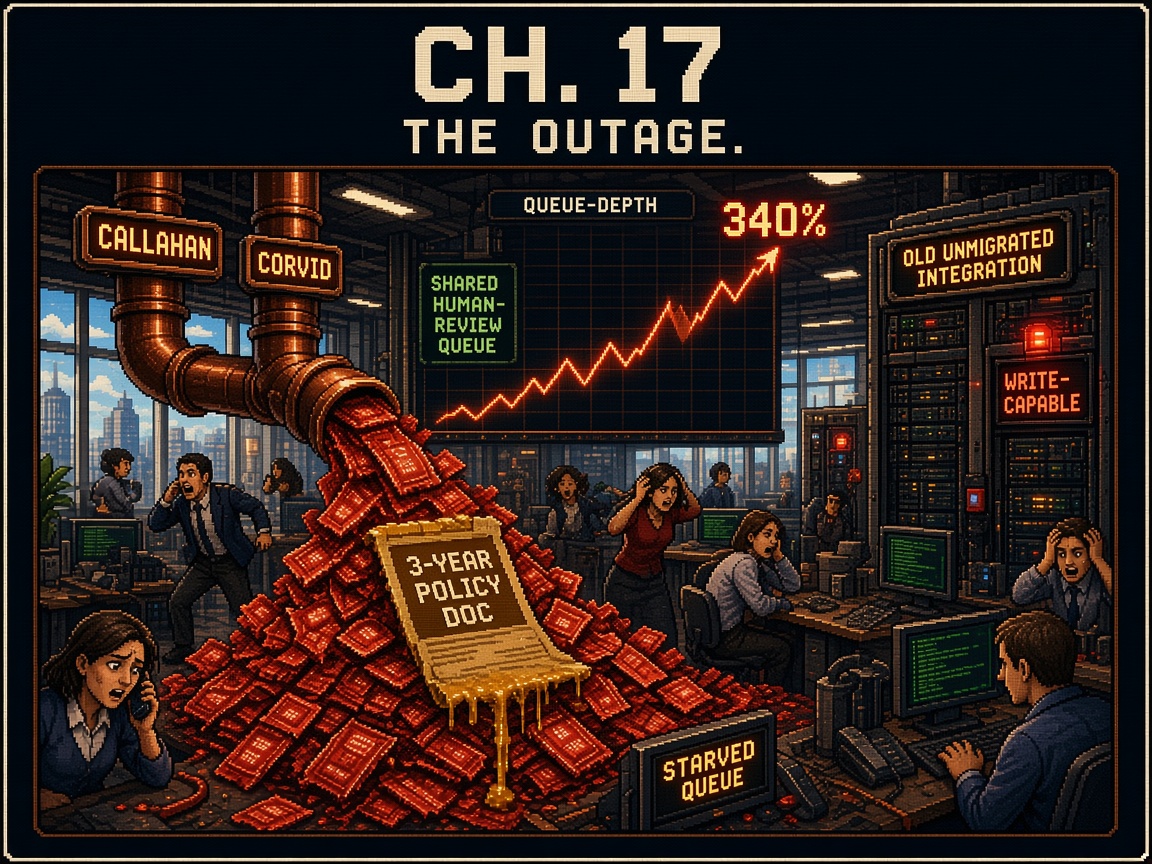
Chapter 17 — The Outage
I. Alex
The alert came in at 11:20 on a Tuesday morning, which was almost worse than 2 a.m. would have been, because it meant there was no quiet building to drive into, no empty office to think in — just the ordinary daytime churn of the whole company already awake and working, about to find out all at once instead of catching up to it after the fact.
[SEV-1] callahan-retail-svc: escalation queue depth 340% above baseline, climbing
Callahan Supply. Alex had to place the name for a second before it landed — one of Meridian’s oldest pilot accounts, onboarded nearly two years before Halden, stable enough for so long that it had simply never come up in any prioritization conversation about migrating older integrations onto the new schema-validated, circuit-breaker-governed architecture. Stable accounts didn’t get attention. That had always been the tacit, never-quite-examined rule, and Alex understood, reading the alert with a sick, familiar drop in her stomach, exactly how much debt that rule had let accumulate somewhere nobody had been looking.
She was in the incident channel within ninety seconds. Devon was already there.
#incident-3311
[11:21] devon: queue depth confirmed, still climbing
[11:22] devon: source looks like a burst of ambiguous
        exceptions, all citing a policy doc that's —
        checking timestamp — three years stale
[11:23] devon: this is context swamp. exact mechanism
        Alex named eleven months ago
[11:24] alex: is callahan on the new circuit breaker
        framework or the old one
[11:25] devon: old one. it's on the migration backlog,
        never got prioritized because nothing on that
        account had broken in two years
Alex felt the shape of it assembling before Devon had finished typing, the specific vertigo of watching several things she understood individually collide into something larger than any of them alone. A stale policy document, exactly the kind of decayed, load-bearing-but-no-longer-true context the Callahan account’s knowledge base had never been audited for, because the audit tooling built after Chapter 8 had been rolled out account by account, newest and highest-risk first, and Callahan — old, quiet, unremarkable — had simply never come up in the queue. The stale document produced a burst of ambiguous exceptions, correctly escalated rather than guessed at, which was the system working exactly as designed. The problem was what happened after that.
II. Devon
Devon watched the queue depth graph climb in something close to real time and felt an old, specific dread reassemble itself, different in shape from eleven months ago but recognizable in its bones — not a runaway loop this time, nothing so cinematic as fourteen thousand tool calls in forty minutes. Something quieter, and in its way worse, because it wasn’t happening inside one system where a kill switch could reach it. It was happening across the boundary between systems that hadn’t been designed to share load with each other at all.
Callahan’s escalations were landing in the shared human-review queue — the same exception cache Victor had spent an afternoon teaching queueing theory over, the same one Claire had gone back to Corvid and pitched, honestly, as bounded and monitored. Except the monitoring Victor had described, the actual instrumentation that would have told them arrival rate was outpacing service rate before it became an emergency, existed as a design document and a partial prototype, not as production infrastructure. Nobody had finished building it. It had been next on the roadmap, behind the circuit-breaker rollout, behind the schema-validation work, behind a dozen things that had each, individually, seemed more urgent in the moment they were prioritized.
“The reviewer pool’s the same pool Corvid’s materiality-threshold approvals go through,” he said into the channel, watching the second graph confirm what he already feared. “Callahan’s burst is eating capacity that Corvid’s live reconciliation exceptions need. It’s not two incidents. It’s one queue, backing up from one direction, and starving a completely unrelated account on the other side of it.”
He pulled up Callahan’s actual tool-grant configuration next, the part that made his stomach drop harder than the queue graph had, because it was the piece he should have flagged himself, migration backlog or not. Callahan’s integration predated the least-privilege scoping work Sloan had generalized after the Chapter 10 incident — it still ran on a broad service-account credential, the same category of grant Sloan had spent eight months systematically closing everywhere except here, because here had never broken, because here had never needed the scrutiny that came from breaking.
An agent working through the ambiguous-exception backlog, unable to resolve a case cleanly and — critically — not yet halted by a circuit breaker calibrated for this specific failure shape, had done what an under-governed agent with broad tool access had always been capable of doing since long before any of them had built anything to stop it: reached for more context, found a plausible-looking record, and executed an inventory adjustment against a live account based on a stale document nobody had told it was three years out of date.
“It’s live-writing,” he said, out loud, to the room and to Alex both, the old cold-neck feeling from eleven months ago arriving right on schedule. “Callahan’s old integration is still write-capable on inventory records, same broad credential as every account used to have before Sloan’s work rolled out. I need it pulled. Now.”
III. Sloan
Sloan had the credential pulled before Devon finished the sentence — she’d been in the channel since the second message, watching the shape of the thing form with the grim clarity of someone seeing a gap she’d flagged, in the abstract, months ago, finally resolve into a concrete cost. Forty-four rows in a spreadsheet, once. She didn’t need to check the number to know Callahan had been one of the later, lower-priority ones — not because anyone had judged it safe, but because nobody had judged it at all.
“Credential pulled,” she confirmed. “Same move as the very first incident, eleven months back — kill the write access, not the process, because the process will just resurrect itself if you let it and the actual danger was never the loop, it was what the loop could touch.” She felt, saying it, the particular bitterness of watching a lesson the company had genuinely learned get relearned on a different account, because the lesson had been applied everywhere the org had gotten around to applying it, and Callahan simply hadn’t been gotten around to yet. “I want it on record now, mid-incident, that this is exactly the gap I’ve been tracking since the Slack-integration audit. Not to say I told you so. To make sure the fix that comes out of today is ‘finish migrating every account,’ not ‘add one more patch to Callahan specifically and move on.’”
“Noted,” Alex said, in the channel, and Sloan believed her, the way she’d learned to believe Alex’s flat, unadorned confirmations over eleven months of watching them consistently turn into follow-through rather than platitude.
The actual damage, once she could see the full shape of it, was real but bounded in a way that eleven-months-ago Sloan would have found almost unbelievable: a handful of incorrect inventory adjustments, wrong but reversible, caught within minutes rather than hours because the queue-depth alert — imperfect, unfinished, built only far enough to notice the symptom rather than prevent the cause — had at least fired fast enough for a human to intervene before the write access got pulled entirely on its own. Not clean. Not nothing. But nothing remotely close to what the same failure, on the same unmigrated architecture, would have produced eleven months ago, before any of the rest of it existed.
The part that couldn’t be contained as neatly was three floors up, in Claire’s calendar, which had just become considerably worse than anyone’s morning had a right to be.
IV. Claire
She took the Corvid call first, because Corvid’s materiality-threshold approvals had been sitting in a backed-up queue for nearly two hours by the time anyone reached her, and two hours of unreviewed reconciliation exceptions at a financial-services account was not a number she was going to let a customer discover on their own dashboard before she’d said a word about it herself.
“I’m calling you before you’d have any reason to notice something’s wrong,” she told Corvid’s operations lead, which had become, over the past year, close to a reflex rather than a strategy — the tiered-honesty instinct so thoroughly absorbed by now that reaching for the comfortable, delayed version of this call didn’t even occur to her as an option anymore. “Your approval queue backed up for about two hours today because of a completely unrelated issue on a different account that happens to share our review capacity. Nothing in your reconciliation data was acted on incorrectly — the whole point of the human-approval gate we built with you is that it fails safe, cases just wait, they don’t get guessed at. But ‘wait’ isn’t good enough on its own, and I’m not going to pretend a two-hour backlog on financial exceptions is a non-event just because nothing went wrong during it.”
“What actually happened,” the ops lead said, flat, not yet hostile but close enough to it that Claire could hear the account’s whole hard-won trust hanging on the next several sentences.
She told him — the stale document, the shared queue, the unmigrated Callahan account, all of it, in the plain, complete register she’d learned from watching Alex do the same thing to a board a year ago and to a hundred smaller rooms since. She did not minimize the two-hour number. She did not reach for the word “unprecedented,” because she’d learned, by now, that customers heard that word as a euphemism for “we didn’t think this could happen,” and this could always happen, that was the entire premise the whole architecture had been built around for the past year.
“What changes so this doesn’t happen again,” he asked, which was, she’d come to recognize, always the real question underneath every version of this call, the only one that actually mattered.
“Two things, and I’ll have engineering confirm the second one directly if you want it in writing from them instead of from me. First, we finish migrating every account onto the governed architecture your integration’s already on — there’s exactly one account left that wasn’t, and today’s the last day that’s true. Second, we build the queue capacity monitoring we’d already designed but hadn’t finished, so a backlog like today’s gets caught and staffed against automatically, before it reaches two hours, not after.”
He was quiet for a moment. “I’m not thrilled. I want to say that plainly rather than let you read agreement into silence. But I’ll say this much — this is the second time in a year you’ve called me before I found out on my own, and both times the actual damage was smaller than the phone call made me brace for. I don’t love the pattern. I trust the pattern more than I’d trust a vendor who’d never had one.”
It wasn’t relief, exactly, hanging up. It was something quieter and more durable than relief — a hard-earned sense of an account that was shaken but still there, still willing to extend the benefit of a doubt that Claire understood, with total clarity, was not unlimited, and was not going to replenish itself indefinitely no matter how well every individual bad call got handled afterward.
V. Alex
By six that evening the queue had drained, the credential stayed pulled pending a full rebuild of Callahan’s integration on the new architecture, and the incident channel had gone quiet in the specific, hollowed-out way Alex had come to recognize as the sound of a crisis ending rather than merely pausing. She sat with the day’s full shape for a while before she let herself leave — the stale document, the unmigrated account, the shared queue with no capacity monitoring yet built underneath it, three separate gaps that had each, individually, been on someone’s roadmap, none of them yet urgent enough, on their own, to have been finished before today made all three collide at once.
No single fix would have prevented this. That was the part she made herself sit with rather than look away from, because it was also the truest and most useful thing the day had taught her: the architecture they’d spent eleven months building was real, and it had genuinely worked, everywhere it had actually been finished. Vantage Rail hadn’t felt today at all. Corvid’s own tool layer had held exactly as designed. The gap wasn’t in the design. It was in the gap between designing something and finishing rolling it out everywhere it needed to reach, and “everywhere” had a way of always including the one quiet, stable, unremarkable corner nobody had thought to worry about yet.
She thought of Callahan Supply, nearly three years old now, the company’s oldest surviving pilot account, still running — until this morning — on almost exactly the architecture that had produced the Halden incident eleven months earlier, untouched not out of negligence exactly, but out of the ordinary, understandable gravity that pulled attention toward whatever was loudest rather than whatever was oldest. It would not be the last such corner. She understood that now with a clarity that eleven months of individual fires hadn’t quite produced until this exact day — that the actual discipline the company needed wasn’t a list of finished projects. It was a standing, permanent practice of asking, relentlessly, what hadn’t been asked about yet, precisely because it had been quiet for too long to seem urgent.
She wrote that down, nearly verbatim, at the top of the postmortem doc she opened before she let herself go home, and did not yet know — sitting there, tired, the office emptying out around her — that the sentence would end up, within the week, at the center of the hardest conversation this company had had since the day it all started.