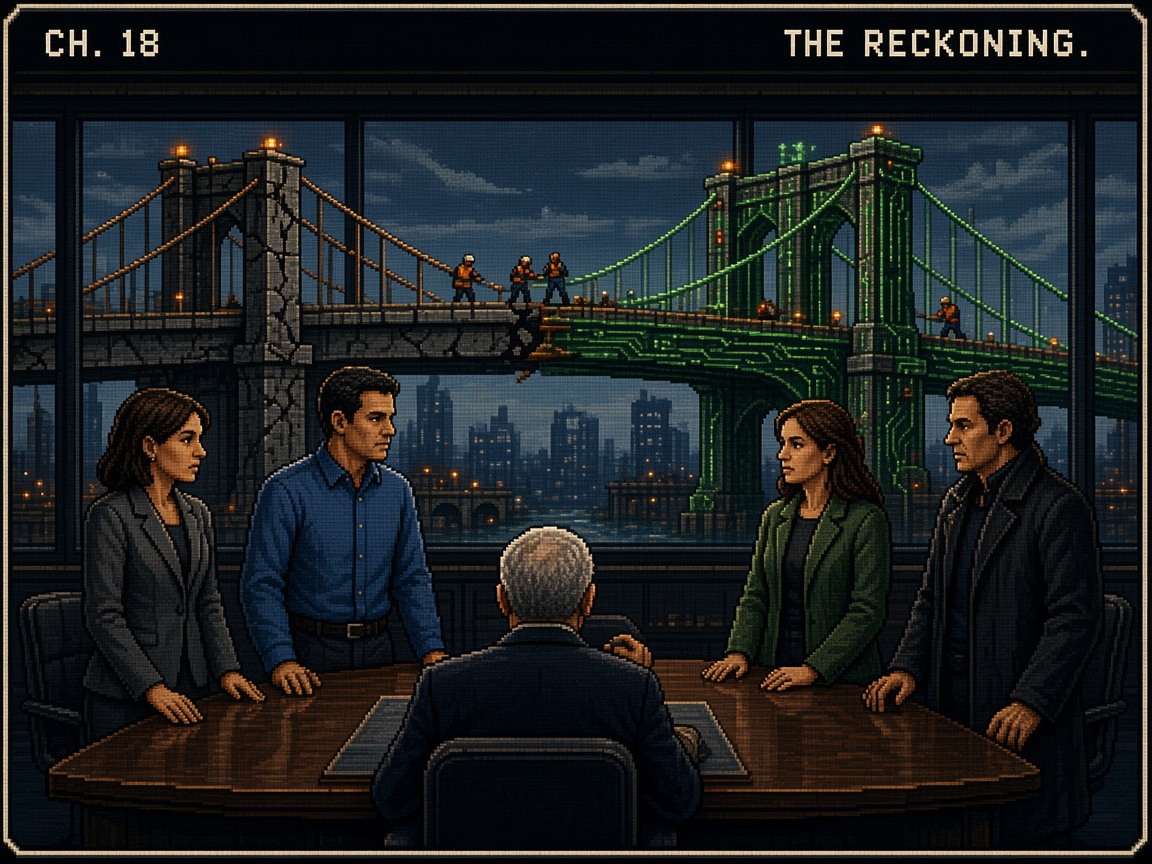
Chapter 18 — The Reckoning
The board meeting got moved up, which Claire had expected the moment Harmon’s assistant emailed to reschedule it a full ten days earlier than planned, and which she understood, reading the email twice before she let herself feel anything about it, as its own kind of message: the Callahan incident had traveled further and faster than a two-hour, mostly-contained queue backup should have, by any purely technical accounting of its severity. It had traveled because Corvid’s evaluation committee had a seat, one degree removed, on a conversation that eventually reached an investor who also sat on Meridian’s board, and because “financial-services account nearly lost after an AI incident” was a sentence that traveled at a speed no engineering severity rating could keep pace with, however contained the actual damage had been.
She spent the ten days doing something she hadn’t done, in quite this way, in the two years she’d been at Meridian: she asked Alex, Devon, and Sloan to come into the room with her, not to brief her beforehand so she could carry the story alone, but to actually be there, together, in front of the board, as themselves.
“I want to say something plainly before we walk in,” she told the three of them, the morning of, in the same small conference room where a much earlier version of this exact group had first found itself in the same configuration, adversarial rather than aligned, eleven months and what felt like a different company ago. “I think there’s a version of today where the board’s instinct is going to be to pull back — reduce autonomy broadly, slow everything down, treat ‘AI incident’ as proof the whole approach was too aggressive from the start. I don’t think that’s the right read of what happened, and I don’t want to be the only person in the room making that case. I want them to hear it from all of us, because I think the case is stronger built from four different angles than from one polished slide.”
“It’s the wrong read,” Alex said, without hesitation, and outlined it exactly as she’d already written it, days earlier, at the top of a postmortem doc none of them had fully appreciated yet as the thesis it would become. “Every account that had the finished architecture didn’t feel Tuesday at all. The account that did was the one piece of the company that hadn’t gotten the discipline yet, not because the discipline doesn’t work, but because we hadn’t finished rolling it out everywhere it needed to reach. Pulling back broadly punishes exactly the wrong thing. It would be like responding to a bridge failure by driving more slowly over every bridge in the network including the ones engineered to a completely different, newer standard, instead of finishing the retrofit on the one bridge that was still built to the old one.”
Harmon opened the meeting the way Claire had learned, over two years, that he always opened a meeting he considered serious — no small talk, straight to the number that had brought everyone into the room early. “Walk us through it. All of it. I don’t want the version with the rough edges sanded off.”
Claire didn’t give him that version. She gave him the real one — Devon narrating the technical mechanism with the same plain, complete honesty he’d brought to his own postmortem, Sloan laying out exactly which gap had been closed everywhere except one account and why that account had been the one left behind, Alex naming, without hedging, that the compressed six-week Corvid timeline months earlier had contributed pressure that produced a different, now-resolved gap of its own. She had rehearsed, in her head, a version of this presentation that framed every hard fact in its most flattering light. She didn’t use it. She’d learned, somewhere in the last year, that the flattering version cost more in the long run than the true one, and she no longer trusted herself to tell the difference reliably enough to risk it in a room this consequential.
“So the honest summary,” Harmon said, when they’d finished, “is that the thing you’ve spent eleven months building actually worked, everywhere it was actually finished, and failed exactly once, in exactly the one place it hadn’t reached yet.”
“That’s the honest summary,” Alex said. “I want to be equally honest about the corollary, because I think it’s the harder and more important part: ‘everywhere it was finished’ is not the same as ‘everywhere,’ and I don’t think we’re done finding the corners that haven’t been reached yet. I think there will be another Callahan, some other quiet, stable, unremarkable piece of this company nobody’s thought to worry about, unless we change how we prioritize this work — not as a project with an end date, but as a standing practice with its own permanent headcount and its own permanent urgency, regardless of how quiet any given week’s incident log looks.”
Claire watched the board absorb that, watched the specific weighing-of-costs expression cross more than one face in the room, and understood this was the actual moment, the one the whole meeting had been building toward — not whether to punish the mistake, but whether the room believed the fix on offer was real engineering discipline or merely a more articulate version of “trust us.”
“What’s the alternative,” said a board member Claire didn’t know well, a recent addition, cautious in exactly the way new board members tended to be before they’d developed a feel for the company’s actual risk tolerance. “Pull back the autonomy tier broadly. Slow the whole product line down until you’re more confident across the board, not just on the accounts that happen to have gotten priority.”
It was Victor, seated in his usual observer’s chair against the wall, silent until now, who answered — not loudly, not with any particular urgency, in the same unhurried register Claire had come to recognize, across a year of watching him work, as the sound of someone about to say the one sentence that would actually reorganize the room.
“That’s the response of an organization that’s frightened, not an organization that’s learned something,” he said. “I understand the appeal. It feels like caution. It is, in fact, the less rigorous option, not the more rigorous one, and I’d ask this board to sit with that inversion for a moment rather than reach past it toward whatever feels safest to say in a room like this one. A blanket pullback doesn’t distinguish between the parts of this system that are genuinely well-instrumented and the parts that aren’t — it treats a bridge built to spec the same as the one that wasn’t, purely because they’re both bridges, which is precisely the kind of averaging-over-real-differences that produced Tuesday’s incident in the first place. The disciplined response is harder, and less immediately reassuring to say out loud in a boardroom, and it is the only one that’s actually informed by what happened rather than merely frightened by it: finish the work. Everywhere. On a schedule this board actually funds and actually holds this team accountable to, rather than treating it as something that gets deprioritized every time something louder shows up. The alternative isn’t safety. It’s a different, less examined kind of risk, dressed up as caution because it feels like doing something.”
The room was quiet for a moment in the way Claire had learned, across a year of very different rooms, to recognize as an idea actually landing rather than merely being tolerated.
“What would ‘finish the work, properly’ cost,” Harmon asked, “and what would it cost us commercially if we do it right instead of moving on to the next quarter’s growth number.”
Claire answered that one herself, because it was, finally, entirely her question to answer, the one she’d spent a year learning to answer honestly instead of optimistically. “It costs real headcount, permanently, not as a project that ends. It costs some velocity on new accounts while the existing ones finish migrating. And commercially, it costs us nothing we haven’t already priced in, because I am not going to sell autonomy tiers to new accounts faster than the architecture underneath them can actually support — I tried the other version of that math over a year ago, in this exact room, and I don’t want to try it again. What it buys us, if we do it, is a company that can tell Corvid, and every account after Corvid, a true sentence about what’s actually finished and what isn’t, instead of a sales pitch. I think that sentence is worth more than another quarter’s growth number, and I did not believe that a year ago, and I believe it now because I’ve watched what happens on the other side of not believing it.”
Harmon looked around the room, at Alex, at Devon, at Sloan, at Victor, at Claire, and something in his expression settled into a decision Claire recognized before he said it out loud. “Fund it properly. Full headcount, standing practice, not a project with an end date — Alex’s framing. And I want a report back from this exact group, together, in this room, on a fixed cadence, not a slide Claire narrates alone. If this is going to be how the company actually operates, I want the board seeing it operate that way.”
It wasn’t relief that Claire felt, walking out, though there was some of that underneath everything else. It was something closer to the specific, hard-won satisfaction of watching a fight she’d started, a year ago, in this same room, from the opposite side of the table, finally resolve into something she no longer had to fight alone — and underneath that, quieter, the plain understanding that Corvid’s own survival as an account, and everything the deal represented about whether this approach could actually work at the scale the board wanted, now rested entirely on whether the four of them, together, could finish what they’d started before the next quiet corner of the company found them first.