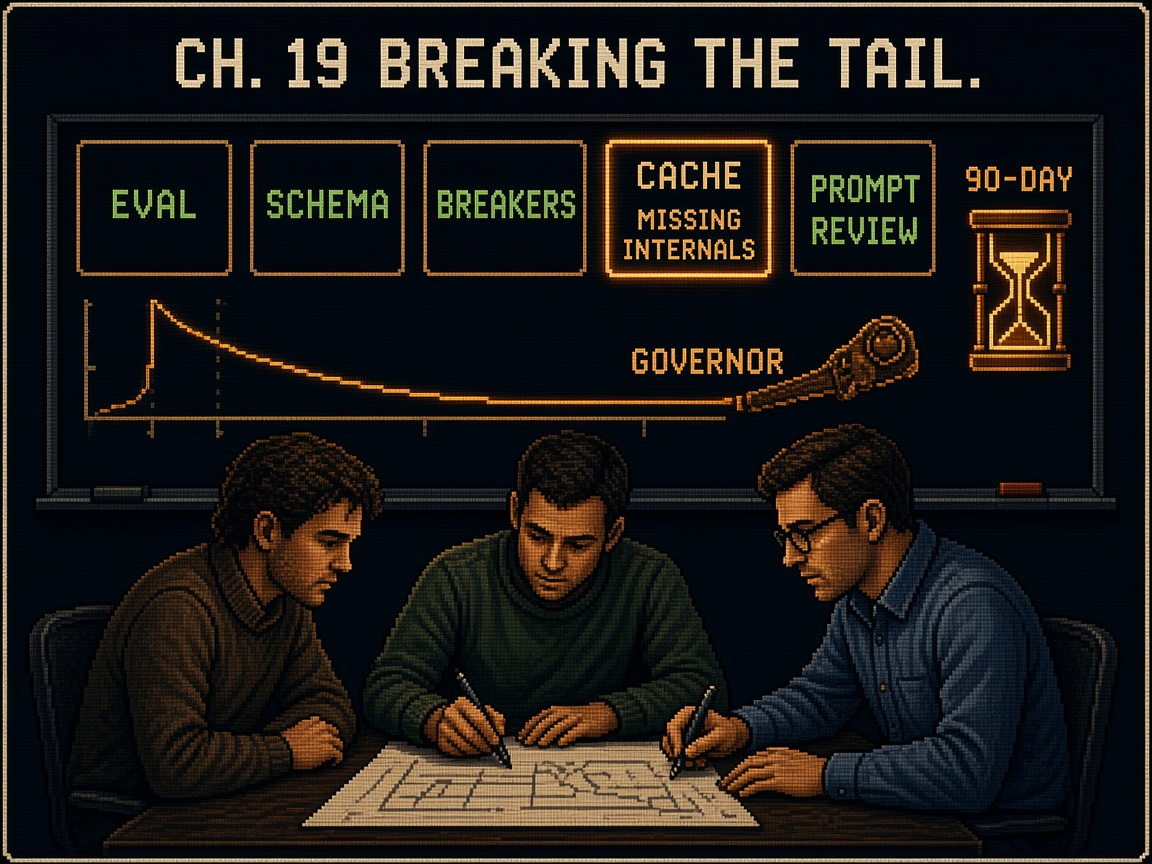
Chapter 19 — Breaking the Tail
The board’s mandate translated, within a week, into a name, a budget line, and a deadline, in that order, which was about the order Alex had learned to expect anything at this company to actually become real. Claire called it the Continuity Program in the first version of the charter document, a name Alex found herself quietly grateful for — not dramatic, not a rebrand of the last eleven months as some kind of heroic turnaround, just a plain description of what it was: the work of making sure what had been built kept getting finished, everywhere, permanently, instead of stopping the moment the most recent fire went out.
The deadline was the part that gave the whole thing its shape. Corvid’s evaluation committee, after the Callahan incident’s aftershock reached them secondhand, had not pulled the account — Claire’s honesty in the moment had bought exactly the credibility it was meant to buy — but had attached a condition to staying through the contract’s renewal window: a joint technical review, ninety days out, in which Corvid’s own engineering team would audit the finished state of the architecture directly, not take Meridian’s word for it. Ninety days. Alex had sat with that number for a full afternoon before she let herself feel anything about it beyond the flat, useful fact of its existence — not enough time to build everything from nothing, which was fine, because nothing was not what they were building from. Enough time, if she was honest and precise about what was actually still missing, to finish it.
She spent that first week doing the thing Victor had taught her to do with almost every hard problem this company had handed her, going back to the whiteboard in his office and redrawing what they actually had, not what the roadmap decks had implied they had.
“Four pieces,” she said, mostly to herself, mapping it out while Victor watched from his chair with the specific patient attention he brought to a student finally doing the derivation without being walked through it. “Eval suite — real, versioned, growing, genuinely catching regressions before they ship. That one’s solid; it’s proven itself twice now. Least-privilege tool scoping and schema validation — Sloan’s converged them into one layer, and it held under a live adversarial attack on Corvid, which is about as strong a proof point as we’re going to get. Circuit breakers — generalized, company-wide framework exists, Devon’s rolled it out everywhere except the accounts still on the old architecture.” She paused at the fourth box, the one that had actually failed, three weeks earlier, in the exact way Victor had warned it would if left half-built. “And the exception cache. Which is the one that isn’t real yet. It exists as a routing destination — cases go somewhere when the other three layers flag them — but it doesn’t have the actual queueing infrastructure underneath it. No measured arrival rate, no measured service rate, no capacity alerting, none of the things you told Claire and me about, right here in this room, not so long ago.”
“That’s the honest inventory,” Victor said. “What’s missing from it?”
Alex looked at the diagram a while longer, feeling for the gap the way she’d learned to feel for one rather than simply listing what was visible. “Prompt versioning,” she said finally. “Devon’s patch list turned into eval cases, which was real progress, but the actual review process for a prompt change is still, underneath the eval gate, mostly Devon or whoever’s closest reading a diff and using judgment. We built the sensor. We didn’t build the equivalent of a real code review for the thing the sensor is watching — a second engineer who can actually evaluate what a prompt change does, not just whether the eval suite happens to have a case that catches it if it’s wrong.”
“Then that’s five pieces, not four,” Victor said. “And I’d tell you, if you want the unglamorous truth of it, that the fifth one is the hardest, because it’s the one that depends least on a piece of software and most on a habit the organization has to actually keep — a human discipline of review, which, as we discussed rather pointedly a few weeks ago, is precisely the category of control you cannot fully trust to hold under pressure without something mechanical backing it up. Build the mechanical backing. Don’t just ask Devon to keep doing what he’s already doing more carefully.”
She brought the full inventory to Devon and Sloan together, two days later, in the same conference room the Continuity Program’s charter had first been drafted in, and watched something settle into place between the three of them that felt less like a kickoff meeting and more like a continuation of a conversation none of them had ever really stopped having, across eleven months, in a dozen different rooms.
“I want to propose something that’s going to sound like it’s taking something away from you,” Alex said to Devon, “and I want you to hear the whole thing before you react to the first part of it. I think prompt changes need to go through the same review rigor as a production code change from now on — a second engineer, someone who isn’t you, actually reading and understanding what changed and why, not just checking that the eval suite is green. Which means I want you, over the next ninety days, to actively build a second and third person who can do that review as well as you can, instead of being the only person capable of doing it.”
Devon didn’t flinch from it the way she half expected him to, and she understood, watching him take the idea in, how much distance the last several months had actually put between this version of him and the one who’d shipped an unreviewed fix at 9:40 on a Thursday night. “I already started that with the new engineer onboarding onto the runtime,” he said. “I want to make it real instead of ceremonial. Actual ownership, not shadowing. If Corvid’s audit is going to look at whether this place depends on one person’s judgment holding forever, I don’t want the honest answer to still be yes.”
“And I want the schema-validation layer finished everywhere, not just where it’s been convenient to reach so far,” Sloan said, when Alex turned to her. “Every remaining account on the old architecture migrated, on a hard date, not a rolling backlog that quietly reprioritizes itself every time something louder shows up — which is exactly how Callahan sat untouched for two years. I have the list. I’ve had the list for a while. What I haven’t had, until now, is a board-funded mandate that makes finishing it more urgent than whatever ships next.”
“You have it now,” Alex said. “All of it. Ninety days, real headcount, and a customer’s engineering team checking our work at the end of it instead of just taking our word.”
Nobody in the room treated that as a burden, which was, Alex thought, watching the three of them start sketching a real workplan across the same whiteboard Victor had first drawn a three-box control loop on nearly a year earlier, the clearest evidence yet of how much had actually changed since then — not that the fear was gone, exactly, but that it had turned, somewhere in the last eleven months, into something closer to competence under pressure than panic under it.
“Ninety days,” Devon said, looking at the workplan taking shape, “to finish something that took us eleven months to even understand the shape of.”
“Ninety days to finish it properly,” Alex said. “We understand the shape now. That’s the part that took eleven months. This part is just building it.”
She didn’t fully believe, saying it, that “just building it” was going to turn out to be as simple as the sentence made it sound — she’d learned enough, by now, to distrust any sentence about this system that used the word “just.” But she believed, for the first time since a 2 a.m. page nearly a year ago had first taught her how little of this she actually understood, that the team in this room knew exactly what they were building toward, and exactly what it would take to know, honestly, whether they’d gotten there — which was, she was coming to understand, the entire difference between an organization that survived its own ambition and one that didn’t.