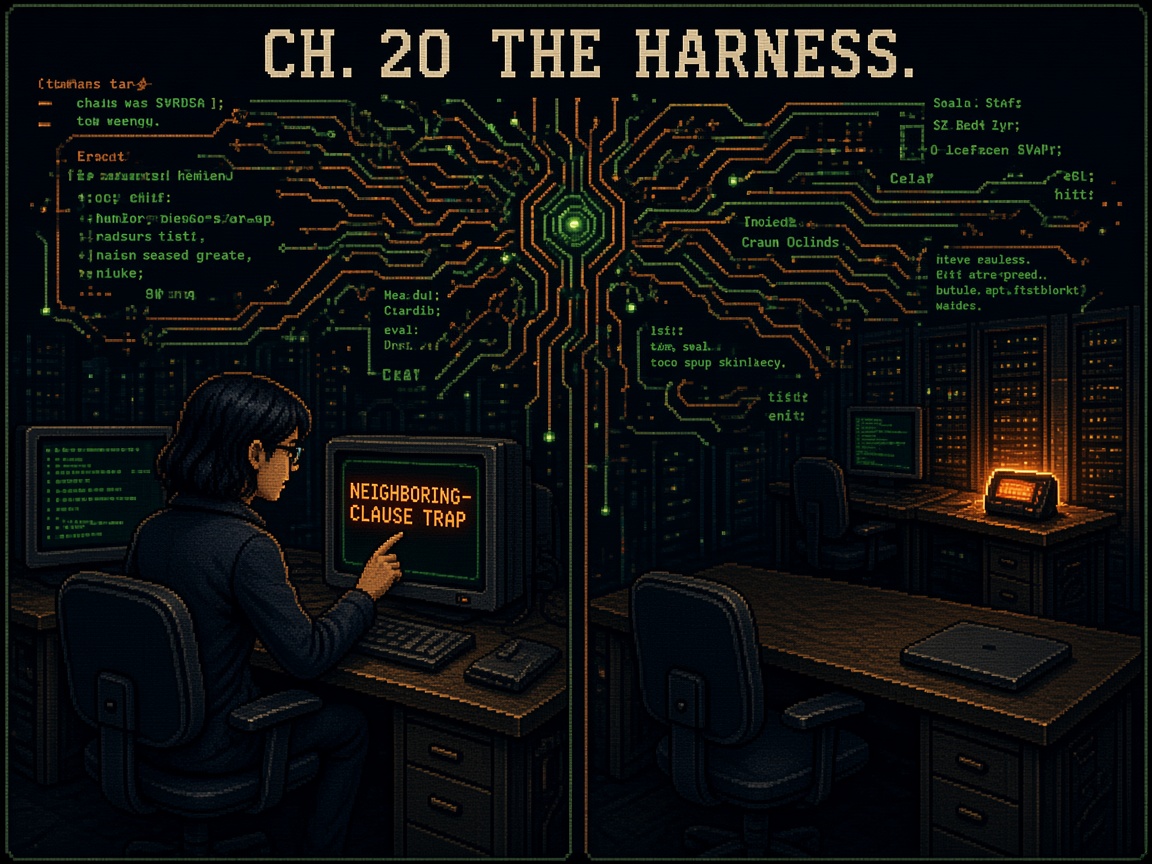
Chapter 20 — The Harness
Nadia Okonkwo had been at Meridian for six weeks when Devon handed her the prompt file for the first time, and he watched her reaction to it — the specific, quiet overwhelm of someone confronting sixteen thousand words of accumulated instruction with no clear map of which paragraph existed because of which incident — with a recognition that surprised him with how much it still stung, a year later, to remember from the inside.
“This is the part I actually apologize for,” he told her. “Not the length. The length is honest — it’s a real record of everything this system has had to learn the hard way. What I’m sorry for is that until about three months ago, none of it was organized well enough for a new person to actually learn from. It was organized well enough for me to remember, which is a very different and much worse thing to optimize for.”
What he handed her instead, this time, was not the raw file but the thing he’d spent the back half of the last several weeks building specifically so this handoff wouldn’t repeat his own first year: a versioned changelog, cross-referenced against the eval suite, that let you pull up any paragraph in the prompt and see, directly, which eval case had been written to protect it, which incident had originally produced it, and which other paragraphs it had any known interaction with. It wasn’t complete — some of the oldest patches predated the changelog and still carried only a best-guess reconstruction of their original justification, a gap Devon privately found more uncomfortable than he let show, a small, specific monument to how much institutional knowledge had simply lived in his head for over a year with no backup. But it was real, and it was growing, and it meant Nadia’s first actual review — a genuine prompt change, not a supervised exercise — happened four weeks into her tenure instead of the ten months it would have taken Devon himself to reach the same point of confidence, back when there had been nothing at all to hand him on his own first day beyond “ask me.”
The review process he’d built around it was, by design, almost boringly rigorous. Every prompt change now required a written rationale — what failure or gap it addressed, what it was expected to change, what it was explicitly not meant to change — and a second reviewer’s sign-off that went beyond checking the eval suite was green. The reviewer had to be able to explain, in their own words, why the change should work, not just confirm that a machine said it did. Devon had resisted the idea, when Alex first proposed it, on the grounds that it would slow everything down to a crawl; he’d been wrong about that, in a way that had taken him most of a month to fully admit even to himself, because the actual bottleneck it exposed wasn’t the review step. It was how much of the prompt’s own logic had never been written down clearly enough for a second person to reason about it at all — which was, once he sat with it, exactly the gap the whole review process existed to close.
The near-miss came in week seven, and Devon would spend a long time afterward turning over how differently the same failure would have landed a year earlier.
Nadia flagged it herself, in a routine review of a change one of the newer platform engineers had proposed — a fix for a minor tone complaint on the Halden account, superficially unrelated to anything sensitive, the exact category of small, reasonable patch that had once shipped in under ten minutes on Devon’s own say-so alone. She couldn’t immediately say why it bothered her. She pulled up the changelog’s interaction map, traced the paragraph the change touched back through its recorded history, and found — the way Devon had found his own four-month regression back in Chapter 9, except this time inside a system built specifically to make finding it fast rather than accidental — that the paragraph in question sat two clauses away from the exact disambiguation logic he’d written, under deadline pressure, the night of the Corvid “aged variance” incident nearly a year earlier. The proposed tone fix, read in isolation, was harmless. Read against that specific neighboring clause, it introduced an ambiguity in exactly the failure mode the disambiguation fix had been built to close.
“I don’t know if this is actually a problem,” she told Devon, bringing it to him not because the process required his sign-off — it explicitly didn’t, by design, since the whole point was that it shouldn’t need to — but because she wanted a second, more experienced set of eyes before she blocked a colleague’s change on a hunch. “It might be nothing. The eval suite’s still green against it.”
He built the test case himself, in about twenty minutes, reconstructing the exact ambiguous phrasing that had caused the original Corvid confusion and running it against the proposed change. It failed. Not catastrophically — nothing was live yet, nothing had shipped, the whole apparatus had done precisely what it existed to do — but cleanly, unambiguously, the kind of failure that would have gone completely unnoticed under the old regime, shipped in ten minutes by someone with no way of knowing a nine-month-old, deadline-shipped fix even existed in that part of the file.
“You caught something the eval suite didn’t have a case for yet,” he told her, “by actually understanding the system well enough to feel that something was off before you could prove it. That’s not luck. That’s exactly what this whole process was built to make possible, and it took you seven weeks to get there, which is — I want you to actually sit with this number for a second — about nine months faster than it took me, because nobody had built you a map yet when I was where you are now.”
She wrote the missing eval case herself, the two of them working through it together, and Devon watched her do it with something that took him a moment to correctly name, sitting there at his own desk instead of hers for once, mostly out of the way rather than driving: relief, plain and uncomplicated, the specific relief of watching a system catch something on its own that used to depend entirely on him personally being awake, available, and lucky enough to remember.
He took the following Saturday off, the whole day, no laptop, a genuinely petty personal milestone he’d told almost no one he was tracking — the first full weekend day in over a year he hadn’t so much as opened Slack, not because nothing happened at the company that day, but because nothing that happened required him specifically, and the pager, when it rang once, briefly, around 4 p.m., went to someone else first, and resolved itself before he even saw the notification.
He looked at it that evening, out of habit more than need, and felt something unfamiliar enough that it took him a moment to place: not the old vigilant readiness, the part of him that had spent fourteen months treating every quiet hour as a countdown to the next fire only he could put out. Just ordinary, unremarkable relief, the kind that came from knowing a system — not a person, a system, built properly, with more than one person able to hold it up — had handled something without him, correctly, the first time it was asked to.
It wasn’t finished. He knew that clearly enough not to let the one good weekend convince him otherwise; there was a full account migration still ahead of Sloan’s team, an exception cache still not built to spec, and sixty days left before Corvid’s engineers came to check all of it for themselves. But for the length of one Saturday, for the first time since a 2 a.m. page a year earlier had first taught him what it felt like to be the only thing standing between a system and its own worst version of itself, he let himself simply not think about it, and the system, entirely without his help, was fine.