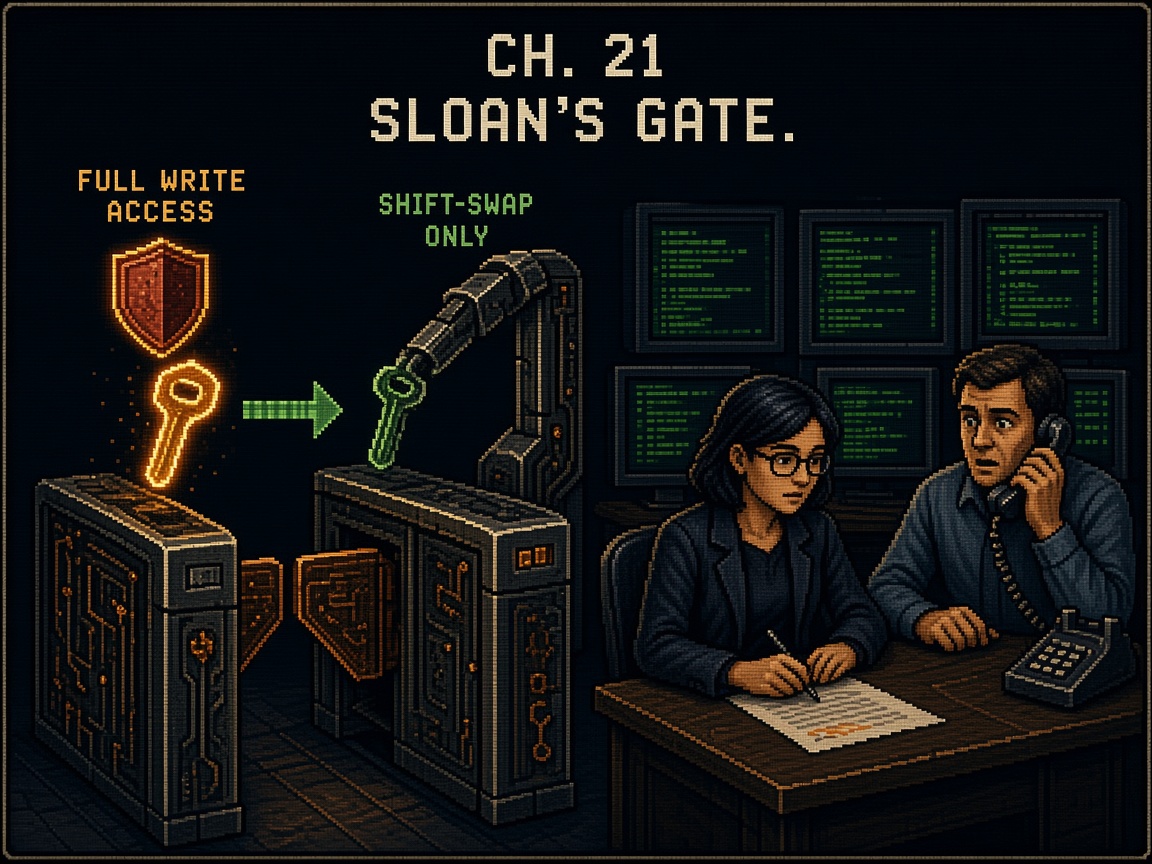
Chapter 21 — Sloan's Gate
The request landed in Sloan’s queue on a Monday morning, filed correctly, through the process that had not existed at all fourteen months earlier and had existed only as a six-to-eight-week bottleneck eight months before that: a new tool integration, request filed by Oskar’s team — the same team, the same engineer, whose Slack-integration scope gap had nearly cost Sloan a genuinely bad week back in Chapter 10. This one wanted write access to a scheduling system for internal support-staff shift swaps, a task shaped, if she squinted, almost exactly like the Vantage Rail maintenance-window grant that had taken six weeks of manual negotiation to resolve a year earlier.
She ran it through the pipeline the way she now ran everything: the schema-validation layer checked the requested tool grant against the task type Oskar’s team had declared and flagged, automatically, in under a minute, that the requested credential was broader than the declared task needed — full write access to the scheduling system, when the actual use case only ever required creating and approving shift-swap requests specifically. The system didn’t reject the request. It routed it back to Oskar’s team with the exact narrower scope it would accept instead, machine-generated, no human judgment call required to produce the correction.
“That’s new,” Oskar said, on the call he’d booked with her an hour later, sounding genuinely surprised rather than defensive this time, a shift Sloan noted with the same flat, unsentimental attention she brought to noticing anything else worth tracking. “Last time I did this, it took me a week just to get someone to tell me the scope was too broad. This time the system told me before I’d even finished writing the request.”
“That’s the whole point of building it,” Sloan said. “I don’t want to be the bottleneck that catches every over-broad grant by hand forever. I want the schema itself to make the over-broad version simply not an option, the same way you can’t compile code that violates a type system. You still need a human — me, or whoever’s covering the gate — for the genuinely novel cases, the ones the schema doesn’t have a clean answer for yet. This wasn’t one of those. This was exactly the shape of gap I closed on your team’s behalf eight months ago, generalized so it catches itself now instead of needing me to catch it.”
“I want to say something, and I don’t say this kind of thing easily, so bear with me.” Oskar paused long enough that Sloan almost prompted him before he continued. “Eight months ago I was annoyed at you. I thought the Slack thing was you finding a problem to justify your own job, honestly — I didn’t say that out loud, but it’s what I thought. I’ve thought about that call a few times since, especially after Callahan, and I wanted to actually say it to you rather than just quietly revise my opinion and never mention it: you were right, and not in a lucky, one-off way. You were right about the shape of the entire problem, months before the rest of us had a reason to take it seriously.”
Sloan let the silence sit for a moment before she answered, not because she needed the pause for effect — she’d never much cared for effect — but because she was, genuinely, deciding how to receive it, an unfamiliar enough situation that it took her an extra beat to find the right register. “I appreciate you saying that. I’m not going to pretend it doesn’t land, because it does. I’ll also say, honestly, that being right early has never felt as good as people seem to assume it does from the outside. Mostly it just felt like watching a slow-motion problem nobody else could quite see yet, and not having a good way to make anyone feel the urgency I felt, until something eventually broke and made it undeniable. I’d much rather be in this version of the conversation — where the system catches it before either of us has to have an argument about it at all — than be right again the hard way.”
“Is that the actual end state? Nobody needs to argue with you anymore because the schema just handles it?”
“For the cases we’ve already learned from, mostly yes. That’s not the same as saying there’s nothing left for me to do — there’s always a new category of tool, a new kind of task, that the schema doesn’t have a clean rule for yet, and that’s where a human still has to reason it through the first time, the way I did with your team a year ago. The difference now is that once we reason through it once, it becomes a rule the system enforces automatically forever after, instead of institutional memory that lives only in my head and has to be re-litigated every time someone forgets it exists. That’s the actual goal. Not a smarter gatekeeper. A gate that doesn’t need a gatekeeper standing at it for the cases already solved, so the gatekeeper’s time goes toward the genuinely new ones.”
She spent the rest of that week doing the part of the job that never made it into any incident report, because nothing about it was an incident: reviewing the adversarial eval suite’s coverage against every migrated account, expanding it where a new class of tool grant had appeared since the last pass, running the whole thing as a standing regression — not a one-time hardening exercise ahead of Corvid’s audit, but a permanent, recurring practice that would keep running, quietly, in the background, for as long as the company kept building anything at all. It was, by any measure that made it into a board deck, entirely unglamorous — no line on a chart moved because of it, most weeks, no announcement worth making. It was also, she’d come to believe with more certainty than she let show even to Alex, the actual foundation everything else in the Continuity Program’s ninety days rested on, in the same unglamorous way a building’s foundation rarely gets mentioned by anyone standing admiring the floors above it.
Devon found her at her desk that Friday, on his way out for what she gathered, from the specific unhurried ease in how he said it, was becoming something closer to a normal weekend for him these days. “Coverage report’s looking good,” he said, glancing at her screen. “You getting any credit for this upstairs, or is it still mostly invisible unless something breaks?”
“Mostly invisible,” Sloan said, without any particular bitterness in it — she’d made her peace with that trade a long time before either of them had met, in a different job, learning the same lesson the hard way. “I’ve made my peace with that. The work that gets noticed is the work that fails loudly. The work I actually want to be doing is the kind that never gets noticed at all, because nothing ever happens that would make anyone look.”
“That’s a strange thing to want to be good at.”
“It’s the only thing worth being good at, in this line of work,” she said, and went back to the coverage report, unbothered, exactly as she’d have said it eight months ago, a year ago, on the first day anyone at this company had bothered to actually listen.