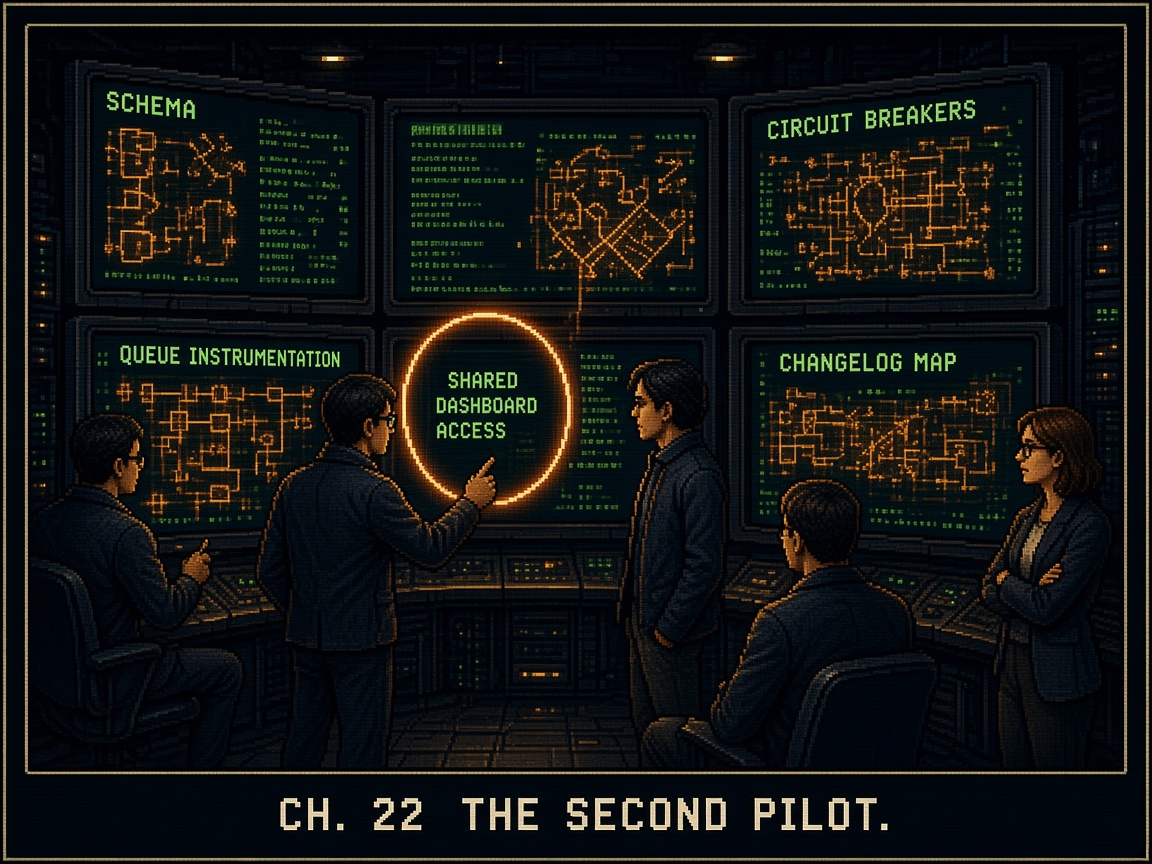
Chapter 22 — The Second Pilot
Corvid’s engineering team sent three people for the technical review, which Claire had expected, and a fourth, unannounced, who turned out to be their head of platform risk, which she had not — a small, deliberate signal, she understood immediately, that this was not a courtesy audit. Corvid wanted to actually know, not be reassured.
She let Alex run most of the day, which had stopped feeling, sometime in the last several months, like a concession of control and started feeling like simply the correct allocation of who should be talking. Claire’s job today was framing, context, the occasional translation when Alex’s precision ran ahead of what the room needed spelled out — not the pitch itself. The pitch, this time, was the architecture, laid bare, exactly as built, for people whose actual job was to find the gap in it if one existed.
“Show us the failure case,” the head of platform risk said, twenty minutes in, in almost exactly the words Marisol Ibarra had used at Vantage Rail nearly a year earlier, and Claire felt the specific vertigo of watching the same question land in a room with an entirely different weight behind it now — not a hopeful prospect testing a vendor’s honesty, but a wary customer checking whether a promise that had already cracked once could actually hold under real scrutiny. “Not the one you built the demo around. Show us Callahan.”
Alex didn’t hesitate, which Claire had known she wouldn’t — they’d agreed, going in, that hiding from the one real incident on this account’s own recent history would cost them more than walking straight into it. She pulled up the actual postmortem, unredacted, and walked Corvid’s team through the full mechanism: the stale document, the unmigrated integration, the shared queue with no capacity monitoring underneath it, the two hours of backed-up approvals that had reached Corvid’s own operations lead directly. She did not narrate it as a triumph. She narrated it as exactly what it had been — a real gap, in a real system, that had produced real, if bounded, consequences.
“And what’s different now,” the head of platform risk asked, “structurally, not just ‘we fixed that one account.’”
“Three things,” Alex said, and Claire watched her count them off with the same flat precision she’d used in a boardroom a year earlier, except the sentence underneath it had changed completely. “Every account, including the ones that had been stable long enough to get deprioritized, is now on the same governed architecture — schema-validated tools, circuit breakers, the works. Not because we found every account and fixed it one at a time, which was the old failure mode. Because we changed how migration gets prioritized at all — it’s no longer ‘whatever’s loudest gets attention.’ It’s a standing practice with headcount attached to it permanently, auditing every account on a fixed cadence regardless of how quiet it’s been. Second, the exception-cache queue that backed up on Callahan now has real instrumentation underneath it — measured arrival rate, measured service capacity, alerting before a backlog reaches the size that one did, not after. I can show you the dashboard live, right now, including what it would have shown us two hours before Callahan actually became visible as a problem, if it had existed then.” She pulled it up. “Third — and this is the one I actually want your risk team to stress-test today, not just take my word for — every prompt change to any agent your account touches now goes through a review process that doesn’t depend on any single person’s judgment holding under pressure indefinitely. I can walk you through exactly how that review works, and I’d genuinely like you to try to find the hole in it, because I’d rather you find it today than six months from now.”
They did try. Corvid’s team spent the better part of four hours doing exactly what Claire had hoped they would and privately dreaded a little at the same time — pulling at every seam, running their own adversarial cases against the schema-validation layer, walking through the review-process changelog Devon and Nadia had built, cross-examining the queueing dashboard’s alerting thresholds with the specific, unsentimental thoroughness of people whose own jobs depended on not being reassured too easily. Claire watched Devon field a question about the prompt-review process with none of the defensiveness she remembered from a much earlier version of him, watched Sloan walk Corvid’s risk lead through the schema-validation architecture with the same flat, procedural clarity she brought to everything, watched Nadia — six months into the job, four months since the near-miss she’d caught on her own — answer a direct technical question about the changelog’s interaction-mapping tool without once looking to Devon to confirm she’d gotten it right.
They found one real gap, near the end of the day, and Claire felt her stomach drop for a moment before she registered what it actually was: not a flaw in the architecture, but a documentation gap — the queueing dashboard’s alerting thresholds weren’t yet visible to Corvid’s own on-call team, only to Meridian’s, which meant Corvid would still be hearing about a backlog from Claire rather than seeing it themselves in real time.
“That’s a real finding,” Alex said, writing it down without any defensiveness at all, the specific ease of someone who’d rather hear the true gap than be told there wasn’t one. “I don’t have an excuse for it — we built the instrumentation for our own visibility first and hadn’t gotten to yours yet. I can have shared dashboard access for your team by end of week.”
“That’s the kind of answer I was hoping for and mostly don’t get,” the head of platform risk said, closing his laptop in a gesture Claire recognized, with a small jolt, as almost exactly Sloan’s own tell. “I want to be direct about where this leaves us. I’m not going to tell you I’m fully at ease — I don’t think ‘fully at ease’ is actually the right bar for a system like this, and I’d trust you less if you were selling me that bar instead of a bounded, honestly measured one. What I can tell you is that everything we tried to break today either held, or broke in a way you’d already found and fixed before we asked, or turned out to be a real but minor gap you owned immediately instead of arguing with us about. That’s not nothing. We’ll recommend continuing the contract through the next renewal cycle, with the shared dashboard access as a condition, and I want a standing quarterly version of today, not a one-time audit — I want to be doing this again in three months, and I want it to be at least this boring every time.”
It wasn’t a triumphant yes, walking Corvid’s team out that evening — Claire understood, with total clarity, that there was no version of this relationship that fully closed the account of trust Callahan had opened, not with one good audit, maybe not ever completely. But it was a real yes, honestly earned, from people whose entire job that day had been to find a reason to say no and hadn’t quite been able to find one that held. She thought, watching their car pull away, of a much earlier version of this exact feeling — the drive back from Fort Worth, a year ago, the good kind of anticlimax, a system behaving itself in front of someone whose trust actually mattered. This one felt different in a way she was still working out how to name. Less like relief. More like proof — not that the system would never fail again, she no longer believed any system earned that kind of promise, but that when it did, next time, it would fail the way today’s questions had assumed it eventually would: caught early, owned honestly, and small.