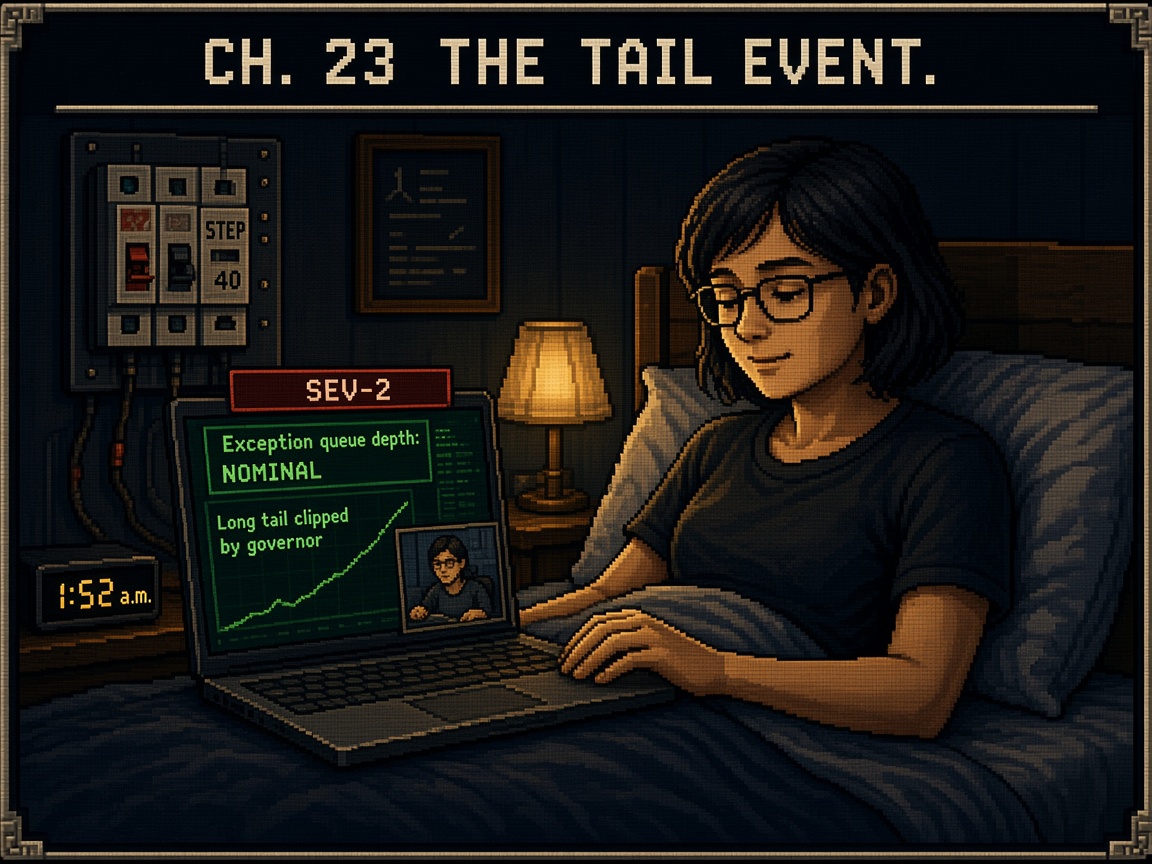
Chapter 23 — The Tail Event
The page came in at 1:52 a.m., seven weeks after Corvid’s engineering team had driven away from a day of trying and failing to find a reason to say no, and Alex was reaching for her glasses before she’d fully processed why the specific timing of it felt like the ground tilting slightly under a year of hard-won progress — not because anything about the hour was unusual, on-call incidents didn’t respect business hours any more than they ever had, but because some old, half-buried part of her had apparently been waiting, quietly, for exactly this kind of page to prove that none of the last year had actually changed anything.
[SEV-2] briarwell-health-svc: circuit breaker triggered, escalated to exception queue
Briarwell Health. A new account, barely six weeks into its pilot, onboarded entirely under the finished architecture — the first customer, Alex registered with a small, distant sense of occasion even at two in the morning, whose entire relationship with Meridian had existed inside the Continuity Program’s discipline from day one, nothing grandfathered in, nothing migrated after the fact. She read the alert a second time, and noticed, with a jolt of something that took her a moment to correctly identify as relief rather than dread, what the severity level actually said. SEV-2. Not SEV-1. Not the middle-of-the-night phone call that overrode Do Not Disturb, the way Halden’s had a year and a half earlier. Just a page, ordinary, escalated, waiting for a human.
She was in the incident channel within two minutes anyway, because habit outlasted evidence, and found Nadia already there.
#incident-3488
[01:53] nadia: circuit breaker tripped clean at step
        count 40, well under the 200 ceiling for this
        integration
[01:54] nadia: source: a genuinely novel data shape in
        briarwell's intake records, not anything in the
        eval suite
[01:55] nadia: exception cache picked it up automatically,
        queue depth nominal, on-call reviewer notified
[01:56] nadia: I'm the on-call reviewer. looking now
Alex read the timeline and felt something unfamiliar settle into place where the old dread usually lived — not absence of concern, she was still fully awake, still tracking every line as it scrolled past, but a kind of concern that had somewhere to stand rather than nowhere. The agent had encountered something none of Briarwell’s onboarding data or eval cases had anticipated — a patient-intake record with a malformed, duplicate identifier structure that made a routine lookup genuinely ambiguous in a way no amount of prior testing could have specifically foreseen, the honest, unglamorous truth of Victor’s oldest lesson finally proven rather than merely argued: you cannot eliminate the tail. You can only make sure the system knows it’s in one.
It had. That was the whole story of the next forty minutes, and Alex watched it unfold with something close to wonder at how little her own intervention was required. The circuit breaker had stopped the loop at forty steps, nowhere near the two-hundred-step ceiling, because Devon’s original discipline — set the threshold from real eval data, not from optimism — had held even for a task category the eval suite had never specifically modeled. The schema-validation layer had, in the same window, rejected two tool calls the confused agent had attempted mid-loop, malformed requests that would once have executed on trust and now simply didn’t, logged and harmless. And the exception cache — the piece that had failed, expensively and visibly, on Callahan seven months earlier — routed the case cleanly to Nadia, queue depth nominal, exactly the bounded, monitored, honestly-described capacity Victor had spent an afternoon teaching a boardroom to understand the shape of.
Nadia resolved it in twenty-three minutes, working the case the way the whole architecture had been built to let a competent second person work it: full context, clear escalation reasoning, no tribal knowledge required that lived only in Devon’s head. She wrote up the malformed-identifier pattern as a new eval case before she closed the incident, not because anyone told her to, but because — Alex understood, reading the case she’d added, with a small, private pride she didn’t try to name out loud to anyone — it had simply become the obvious next thing to do, the reflex the whole system had been designed to produce in anyone who used it long enough to trust it.
Devon, looped in but never needed, wrote a single line into the channel a few minutes after Nadia closed it out. good catch. nothing for me to do here, which is the whole point. going back to sleep.
Alex sat with the closed incident for a while after the channel went quiet, the specific stillness of 2:40 a.m. in an apartment she hadn’t needed to leave, a system three states away that had encountered something genuinely new, been wrong about it briefly, and stopped itself, cleanly, boringly, before the wrongness could become anything a customer would ever need to hear about in a phone call. She thought, without quite meaning to, of Victor’s diagram from what felt like a different lifetime now — the three boxes, the loop, the small unlabeled circle where an entire year’s worth of unexamined assumption had once quietly sat. She didn’t have to translate anything into that language anymore. It had simply become the shape her mind reached for on its own, the way a fluent speaker stops hearing grammar as rules and starts hearing it as sense.
Why did the model do that was not a question she’d asked once, tonight, not even silently. She’d asked, instead, without noticing she was doing it until she looked back over the last forty minutes: where was the gain unbounded, and did the governor hold. It had. That was the whole report. Nothing dramatic enough to make a customer’s morning worse, nothing requiring a board conversation, nothing that would end up, eighteen months from now, quoted in a room the way Devon’s I don’t have a kill switch for this line had ended up quoted in rooms for the better part of a year.
She thought, closing her laptop, that this was probably the actual, unglamorous shape of the thing Victor had been trying to teach her from the very first week — not a system that never failed, because no honest engineer would ever promise that about anything built on a model whose outputs formed a distribution rather than a certainty. A system that failed the way tonight had: small, contained, self-reported, closed out before the sun was up, by someone other than the one person who used to have to be awake for all of it. The tail hadn’t gone away. It had simply, finally, been bounded — measured, expected, planned for, survived — and there was, she understood, letting herself finally feel the relief she’d been too alert to notice thirty minutes earlier, no higher form of success available to a system like this one than precisely that: a bad night that stayed a bad twenty-three minutes, and nothing more.
She went back to sleep a little after three, and did not dream about it, which she would only fully register as its own kind of ending the next morning, turning the night over one more time with her coffee, surprised at how completely the old reflexive dread had finally, quietly, let her go.