Chapter 24 — The Architecture of Survival
Victor told her the rest of the switching-system story on a Thursday afternoon, nearly two months after Briarwell, with no particular occasion attached to it — no incident, no board meeting, just the ordinary quiet of a late afternoon in an office that had, somewhere in the last year and a half, stopped organizing itself entirely around the next emergency. She’d asked, finally, plainly, the way she’d learned to ask most things by now instead of waiting for someone to volunteer them. He’d answered the way he answered most things, unhurried, precise, no more or less dramatic than the facts themselves warranted.
“I was younger than Devon is now,” he said, “working on the exception-handling layer of a regional telecom switch — real physical infrastructure, later a software layer over it, routing calls the automated system couldn’t resolve on its own to a bank of human operators. We knew, the way everyone always knows in the abstract, that the operator queue could back up under load. We had the theory. Queueing math isn’t new; it wasn’t new then either. What we didn’t have was the actual instrumentation to watch it happen in real time, because building that instrumentation was expensive, and unglamorous, and the average case looked fine for years, the way Callahan looked fine for two years, the way most systems that are quietly accumulating a debt nobody’s watching look fine right up until the day they don’t.”
He paused, in a way that told her the next part had cost him something to arrive at even now, decades later. “There was a regional weather event. Not catastrophic in itself — the kind of thing the system should have absorbed without anyone outside the building ever knowing it happened. Call volume spiked well beyond anything our design assumptions had priced in, the operator queue backed up faster than anyone watching a weekly average would have predicted, and because we had no real-time visibility into queue depth, nobody actually understood how bad it had gotten until calls that needed a human — emergency calls, among them, not merely inconvenienced customers — were sitting in a backlog nobody could see. We caught it. Eventually. It was not, by the time we caught it, a small thing anymore.” He didn’t give her the specific cost, and she didn’t ask him to, understanding, in the particular quality of his stillness, that some numbers a person keeps for themselves rather than hands to someone else to carry. “I have spent the rest of my career, in one form or another, trying to make sure nobody I worked with again ever discovered the size of a problem the same way I did that week — after it was already too large to be anything but a catastrophe, instead of while it was still small enough to be merely a number on a dashboard.”
“That’s why the insistence on treating the model as a component instead of a mind,” Alex said, understanding it fully, finally, in a way she realized she’d been circling for a year and a half without quite landing on the actual root of it. “It was never really about the AI specifically.”
“It’s never been about the AI,” Victor said. “It’s about the oldest lesson in this entire discipline, applied to whatever the newest, most impressive-seeming component happens to be in a given decade. A system that behaves unpredictably under load will eventually meet a load large enough to expose that unpredictability, and the only real defense is instrumentation built before you need it, not enthusiasm about how sophisticated the component is. Mechanical switches, human operators, transformer models — the physics of the lesson doesn’t change, only the vocabulary people use to convince themselves this time is different. I’ve watched enough people convince themselves of that to have stopped finding it interesting. I only find it worth the effort of arguing against.”
She didn’t have anything to add to that, and understood, sitting with him in the quiet office, that he didn’t need her to. He’d carried the actual weight of it alone for a long time. What he’d wanted, telling her now, was simply for someone at this company to understand the whole shape of why he’d fought as hard as he had, for as long as he had, over what had sometimes looked, from the outside, like academic stubbornness and had never once, she understood now, been anything other than the most expensive kind of caution a person can earn.
Devon’s team had grown to four by then, Nadia the senior of the three newer engineers under him, and Alex found him one afternoon doing something that would have been unthinkable eighteen months earlier: sitting in on a review Nadia was running, silent, deliberately not intervening, watching her walk a newer hire through the changelog’s interaction-mapping tool with the same patient clarity Devon himself had once had to build from nothing, alone, at 4 a.m., with no one to hand it to him first.
“You’re not going to say anything,” Alex observed, settling into the chair beside him.
“I don’t need to. That’s kind of the whole point of the last year and a half.” He watched Nadia catch a small ambiguity in the newer hire’s proposed change, exactly the way she’d caught the Corvid-neighboring clause months earlier, and something in his face did a thing Alex had learned to recognize as pride without any of the old, complicated weight that used to sit underneath his competence. “I used to think being needed was the same thing as being valuable. Took me most of a year, and a couple of very bad nights, to understand those are actually different things, and that a lot of what felt like being valuable was really just being a single point of failure with better PR.”
“Do you miss it? The version where it was just you.”
He considered the question seriously, which she appreciated, rather than reaching for the easy, expected answer. “Some of it. There was a kind of clarity to it — one person, one system, no ambiguity about who was responsible. I don’t miss the 4 a.m. part. I don’t miss carrying something I had no actual backup for. What I have now is slower in the moment and faster over any span longer than a week, and I’d trade the old version for this one every single time, even on the days it’s genuinely more annoying to build consensus than to just fix the thing myself.” He glanced at Nadia, still working, unaware she was being discussed. “She’s going to be better at this than I ever was, within another year. I mean that as the actual goal, not as false modesty.”
Claire’s office, the following week, had the particular late-afternoon quiet of a quarter that had, for the first time in longer than Alex could easily remember, closed without a single number requiring a caveat attached to it in the board deck.
“I keep waiting for the version of this conversation where I have to talk you into something you don’t want to commit to,” Claire said, only half joking, looking at the renewal numbers on her screen — Corvid, renewed at the higher tier now, Briarwell expanding faster than its initial pilot scope, Vantage Rail’s own renewal conversation, this time, taking eleven minutes instead of six weeks. “It’s strange not having that conversation anymore.”
“We still have it,” Alex said. “It’s just a different conversation now. You don’t come to me anymore asking what we can promise. You come asking what the data actually supports, and I don’t have to talk you out of the gap between those two things, because you already know where the gap usually lives before I say anything.”
“Is that better for you? Genuinely asking. I used to think my job was selling confidence. I think now it’s selling honestly bounded confidence, and I’m not sure I’d have believed eighteen months ago that the second one would actually be the stronger pitch, every single time, without exception.”
“It’s better,” Alex said, “and I don’t think it’s just better for me. I think it’s the only version of this that was ever actually going to survive contact with a customer smart enough to eventually ask the hard question — which, it turns out, is most of them, once you give them a reason to trust that the hard question will get a real answer instead of a deflection.”
Claire looked at her for a moment, something settling into an expression Alex had come to recognize, over a year and a half of an often adversarial, now genuinely collaborative working relationship, as the closest thing to real warmth Claire allowed herself in a work conversation. “I don’t think we’re friends, exactly. I want to say that plainly rather than pretend the last year and a half turned this into something it isn’t. But I trust you completely, which I don’t think I extended to very many people even before any of this started, and I don’t think I’d have gotten here without watching you refuse to let me oversell my way past a problem, more than once, at real cost to both of us in the moment.”
“I don’t think we’re friends either,” Alex said, and meant it as the compliment it was intended as, the specific, hard-won respect of two people who had fought honestly enough, for long enough, to trust each other completely without needing the relationship to be softer than it actually was. “I think we’re something a little rarer than that, and I’m not sure it needs a better name than the one it already has.”
Sloan’s afternoon, the same week, looked almost exactly like every other afternoon of the last several months, which was, Alex understood by now, precisely the point and precisely the compliment. A new tool-grant request sat in her queue — a minor integration for Briarwell’s expanding pilot, routine, the schema-validation layer having already caught and corrected one over-broad scope request before it ever reached her desk. She reviewed the one genuinely novel edge case the system had flagged for a human, gave it twenty careful minutes, approved a narrower version than what had been requested, and moved to the next item in the queue without any particular ceremony attached to any of it.
It would never be a story anyone told at an all-hands, this particular Tuesday, and Alex understood, watching Sloan work through the queue with the same flat, unhurried competence she’d brought to the very first Vantage Rail negotiation eighteen months earlier, that this was exactly what winning actually looked like, in this line of work — not a dramatic save, not a story with a clean beginning and a satisfying end, just a queue that got worked through, quietly, correctly, day after day, by someone whose whole professional signature was making sure nothing dramatic ever needed to happen at all.
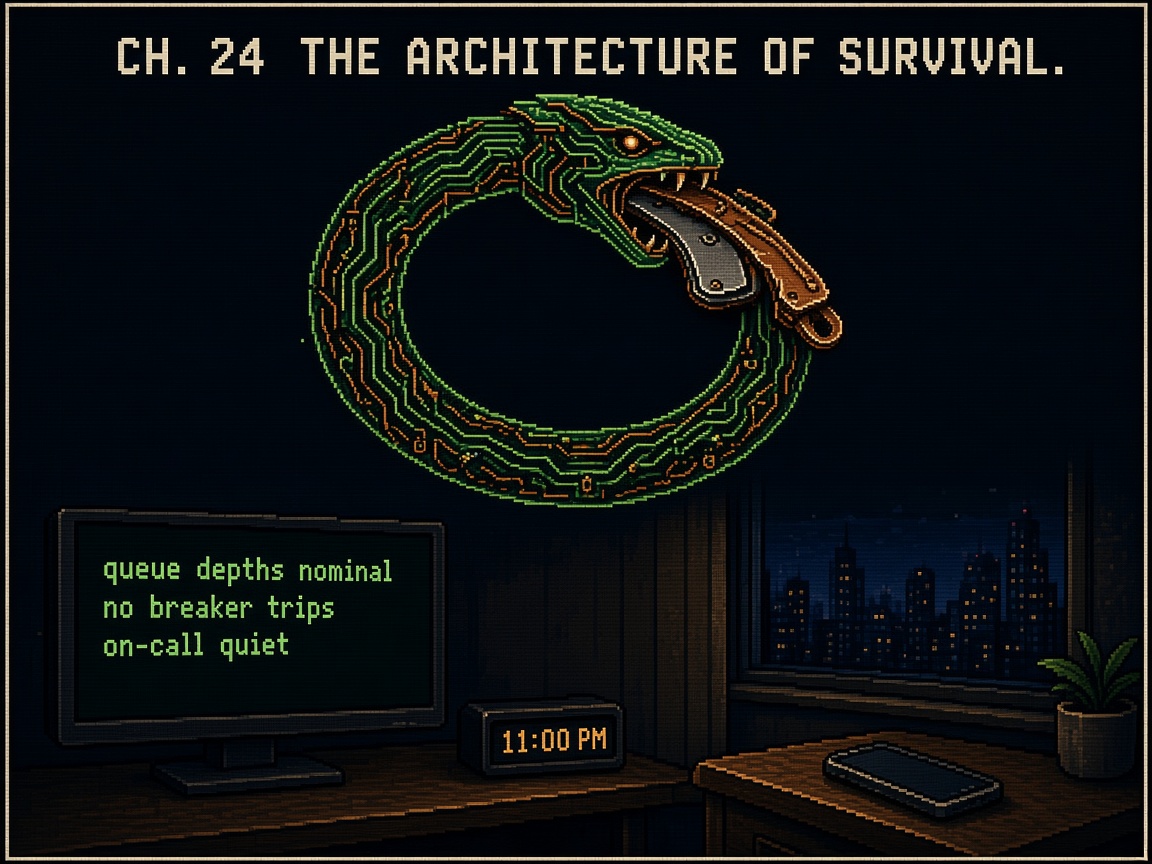
Alex checked the dashboard once more that night, at home, a little after eleven, the way she still did most nights, a habit she’d half expected to outgrow by now and hadn’t quite, and didn’t especially mind not having outgrown. Queue depths nominal across every account. No circuit breaker trips in the last six hours. Nadia’s team, on call tonight, quiet.
She thought, closing the laptop, of a different night a year and a half earlier — the phone call that had overridden Do Not Disturb, the drive in, Devon’s grey face under the kitchen-adjacent fluorescent light, the specific, sick clarity of watching a system do exactly what it was built to do, which had been the entire problem. She thought of the sentence that had followed her around for most of the eighteen months since, in one form or another, through boardrooms and postmortems and a whiteboard in Victor’s office that had, by now, been wiped and redrawn more times than she could count: the bug is that we built a system whose only brake is its own judgment about when to stop.
They’d built the brakes. Not all of them at once, not in the order a clean architecture diagram would have suggested if anyone had known enough, eighteen months ago, to draw one — patched together instead out of real fires, real 2 a.m. pages, real customers who’d had every reason to walk away and mostly, remarkably, hadn’t. It wasn’t finished, in the sense that Victor had taught her, early on, that nothing like this was ever finished — the sensor had to keep growing at least as fast as the thing it watched, forever, a standing practice rather than a completed project, a discipline the company would have to keep choosing to fund and keep choosing to staff for every quarter it existed, for as long as it existed. There would be another Callahan, someday, some other quiet corner nobody had thought to worry about yet. She no longer found that thought frightening in the way it once would have. It was simply the shape of the work, the actual, permanent nature of building something disciplined enough to survive its own ambition — not a single victory, but a practice, held daily, by people who had each, in their own way, learned exactly what it cost to let it lapse even once.
She went to sleep a little after midnight, and did not dream about a runaway loop, and did not wake to a phone call overriding Do Not Disturb, and in the morning the dashboard looked exactly the way it had the night before: quiet, bounded, and entirely, unremarkably, holding.